



Two websites publish an article on the same topic. Both are accurate and both are well formatted. Yet when someone asks ChatGPT or Perplexity about that topic, only one gets quoted. The difference usually isn’t length or keywords. It’s whether the writing is easy to lift, easy to trust and worth repeating.
Writing for AI SEO doesn’t mean writing like a robot. It means writing so clearly that both a person and a machine can pull out the answer. Here are the questions we hear most about it.
What makes a piece of content “quotable” by AI?
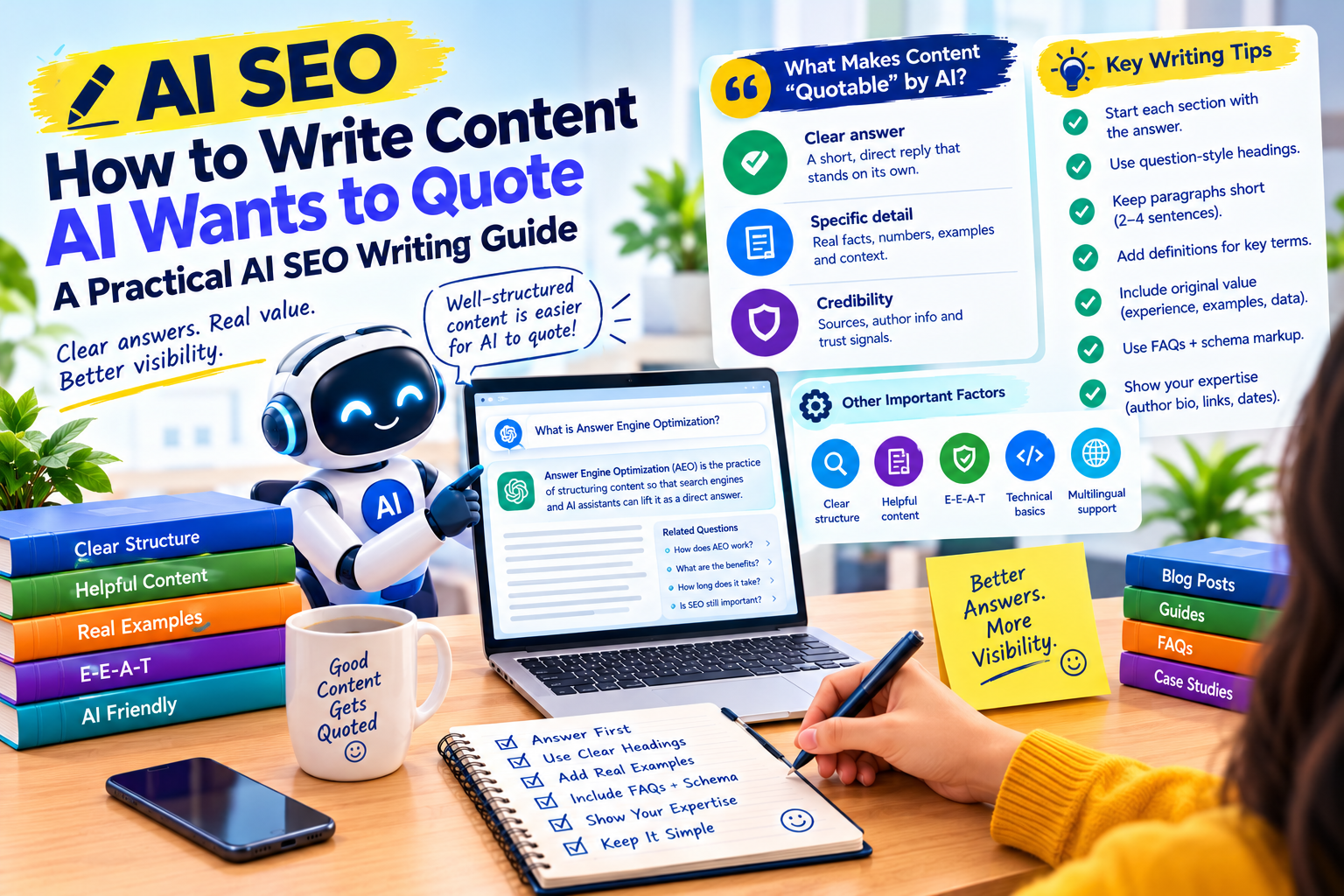
Three qualities show up again and again: a clear answer, a specific detail and a visible source of credibility. A quotable passage can stand on its own. If someone copied just that paragraph into a chat window, it would still make sense and still be useful.
Compare these two sentences. “Many factors affect pricing.” That tells the reader nothing. “Website redesign costs usually depend on the number of pages, custom features and the amount of content that needs rewriting.” That one can be quoted, because it names real factors.
How should I open each section?
With the answer. Many writers build up slowly, adding background before reaching the point. AI tools, and busy readers, prefer the opposite. Put the direct answer in the first one or two sentences under each heading, then add context, examples and nuance.
A simple pattern works well: answer, reason, example. State the point, explain why it’s true, then show it in practice. This structure gives AI a clean excerpt at the top of each section and keeps the rest of the section useful for people who want depth.
Do headings really matter?
Yes. Headings act as labels that tell machines what each section answers. Vague headings like “Key Considerations” waste that signal. Question-style headings such as “How long does an SEO audit take?” match the way people ask AI.
Keep your heading hierarchy tidy: one main title, then clear subheadings in order. Avoid clever or cryptic titles. If a heading wouldn’t make sense as a question typed into a chat box, consider rewriting it.
Should I write definitions?
Absolutely. When someone asks “What is Answer Engine Optimization?”, AI looks for a clean definition. Give it one. Write a short, plain sentence that explains the term without relying on other jargon, then expand.
For example: “Answer Engine Optimization is the practice of structuring content so that search engines and AI assistants can lift it as a direct answer.” It’s short, self-contained and easy to quote. Sarkar SEO encourages clients to include one clear definition for every core term they want to be associated with.
How do I add original value?
This is the part most brands skip, and it’s the part that separates quotable content from forgettable content. AI tools already have access to endless generic summaries. What they can’t invent is your own experience.
Consider adding:
- First-hand observations, such as patterns you’ve seen across client projects.
- Real examples, with details changed or anonymized where needed.
- Simple original data, like a small survey, an internal analysis or a before-and-after comparison.
- Honest opinions, including what doesn’t work and why.
- Practical templates, such as checklists and step-by-step routines.
Only state numbers you can verify. A modest, honest data point is worth more than an impressive statistic with no source.
How long should paragraphs and sentences be?
Short. Aim for paragraphs of two to four sentences and sentences that a reader can follow without re-reading. Long, tangled passages are harder to quote and harder to understand.
Use lists and tables when the content is truly list-like, such as steps, comparisons or specifications. But don’t turn everything into bullet points. A mix of clear prose and well-chosen lists reads more naturally and feels more human.
How do I show credibility on the page?
AI tools lean toward content that shows real expertise. Strengthen your pages with:
- A named author and a short bio explaining their experience.
- Links to credible sources when you cite facts.
- A visible publication or update date.
- Clear contact details and an easy-to-find about page.
- Reviews, case studies or client results where relevant.
Credibility isn’t decoration. It tells readers and machines that a real, accountable person stands behind the words.
Where do FAQs and schema fit in?
An FAQ section is one of the easiest ways to create quotable chunks. Each question-and-answer pair is a self-contained unit. Write answers of about two to four sentences, starting with the direct reply.
Then add FAQ schema, along with Article and Organization schema, so machines can read your structure clearly. It’s a small technical step that helps your good writing get noticed.
Can I use AI to help write this content?
Yes, as a helper, not as the author. AI is useful for outlining, tightening sentences and spotting missing questions. But raw AI output tends to sound like everything else on the web. Add your own knowledge, edit for a natural voice and verify every fact.
A good habit: before publishing, ask yourself, “What does this page say that a generic summary couldn’t?” If the answer is nothing, add something from real experience. At Sarkar SEO, we treat AI as a drafting assistant and keep a human editor responsible for accuracy and tone.
What mistakes make content hard to quote?
- Burying the answer under long introductions.
- Using vague claims with no detail or evidence.
- Stuffing keywords where natural language would do.
- Writing walls of text with no clear headings.
- Copying competitors’ phrasing and adding nothing new.
How do I check whether my content is being quoted?
Each month, ask ChatGPT, Gemini and Perplexity the questions your content is meant to answer. Note whether your brand appears, whether your site is cited and how your ideas are described. Test each question more than once, since answers vary.
Then improve the pages that aren’t getting picked up: sharpen the opening answers, add original insight and strengthen credibility. If you’d like expert help building a content system around this, Sarkar SEO can review your existing pages and show where quotable value is missing.
