



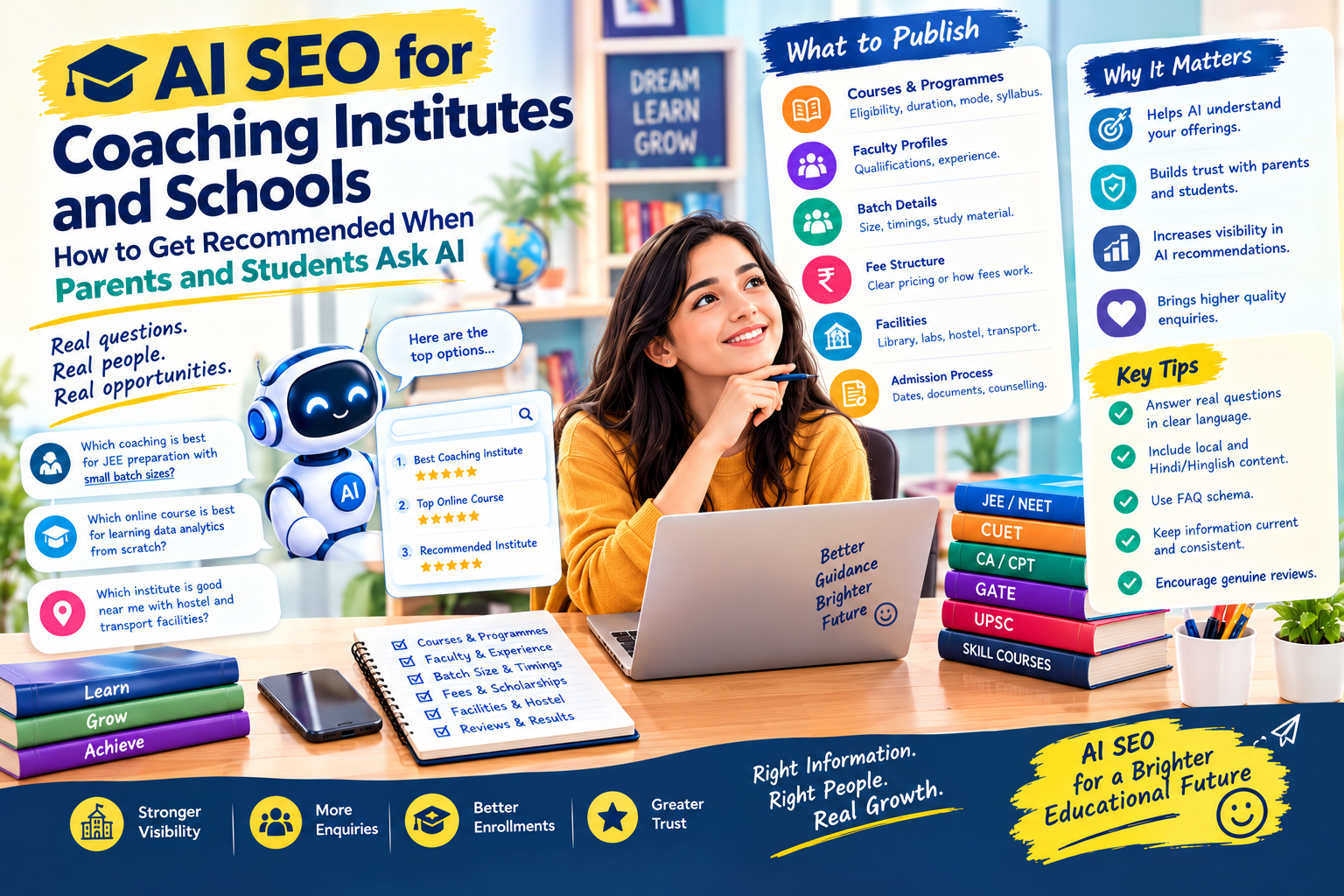
A parent opens ChatGPT and types, “Which coaching institute in Jaipur is good for JEE preparation with small batch sizes?” A student asks, “Which online course is best for learning data analytics from scratch?” Within seconds, the AI names a few options and explains why.
Choosing a school, college or coaching class is a high-trust decision, and families research it carefully. More of that research now starts with AI. Here are the questions we hear most about AI SEO for education brands.
Why does AI SEO matter for education businesses?
Because the decision journey is long and full of questions. Families compare faculty, results, fees, batch size, location, teaching style and reviews. AI assistants condense all of that into a short list.
If your institute isn’t clearly described online, the AI has nothing reliable to say about you, and it will name someone else. Clear, honest information is the foundation of being recommended.
What do students and parents actually ask AI?
Rarely short keywords. They ask specific, personal questions:
- “Which coaching is best for a student weak in maths?”
- “Is an online or offline batch better for class 11?”
- “What is the fee range for CA foundation coaching?”
- “Which institute offers hostel and transport facilities?”
Your content should answer these in plain language. Collect real questions from admission calls, counselling sessions and WhatsApp enquiries, then build pages around them. That is the heart of AI SEO for education: answering what families genuinely ask.
What information should an institute publish?
Put the details people look for in clear text on your website:
- Courses and programmes, with eligibility, duration, mode (online, offline, hybrid) and syllabus coverage.
- Faculty profiles, with qualifications and years of teaching experience.
- Batch details, including batch size, timings and study material.
- Fee structure, or at least a clear explanation of how fees work.
- Facilities, such as library, labs, hostel, transport and doubt-clearing sessions.
- Admission process, with dates, documents and counselling steps.
Avoid hiding these inside brochures or images. An AI can only repeat what it can read. At Sarkar SEO, we often see strong institutes lose visibility simply because their best details sit in downloadable PDFs.
How should I present results and success stories?
Carefully and honestly. Results are the most powerful proof in education, but they’re also where misleading claims creep in. Follow these habits:
- Share verifiable results with context, such as the batch year, the number of students and how results are counted.
- Get written permission before naming students or showing photos.
- Avoid guarantees like “100% selection” or “guaranteed rank.”
- Include student journeys, not just toppers, to show what typical progress looks like.
Advertising rules for educational institutions vary by region, so check the current requirements before publishing results. Being transparent also builds the kind of trust that AI tools and families both look for.
How do reviews and reputation influence AI recommendations?
A great deal. AI tools learn from what students and parents say on Google, education platforms, social media and community forums. Detailed reviews that mention teaching quality, doubt support, discipline and results give AI useful material.
Ask satisfied students and parents for specific feedback, respond politely to every review and address concerns openly. Never post fake reviews or pressure students to write them. Reputation built honestly lasts longer and avoids platform penalties.
What content helps with AEO and conversational queries?
Write guides that match how people ask:
- Comparison guides, such as “Online vs offline coaching: which suits your child?”
- Preparation roadmaps, like a month-by-month study plan for an entrance exam.
- Parent guides, covering how to evaluate an institute and what questions to ask on a visit.
- FAQ pages on fees, batches, refund policy, scholarships and schedules.
Start each section with a direct answer and add detail after. Add FAQ schema so search and AI systems can read your questions and answers cleanly. And include natural Hindi or Hinglish phrasing where it fits, since many families ask in those languages.
How important is local information?
Very, for physical institutes. Keep your Google Business Profile complete, with accurate address, timings, photos, categories and contact numbers. Make sure the same details appear on your website and on education directories.
Add local context in your content, such as the neighbourhoods you serve, transport options and nearby facilities. “Our centre is five minutes from the main bus stand and offers evening batches” is far more useful than “easily accessible location.” Sarkar SEO also recommends listing your branches separately, each with its own clear page, so AI can match the right centre to the right family.
How can I check whether AI recommends my institute?
Use a simple monthly routine:
- Write 20 to 30 questions a parent or student might ask, covering course, budget, location and teaching style.
- Run them in ChatGPT, Gemini and Perplexity.
- Record which institutes appear, how they’re described and which sources are cited.
- Compare month to month and strengthen the weakest pages first.
AI answers vary between runs, so test each question more than once and look at the trend.
What mistakes should education brands avoid?
- Burying fees, faculty and batch details in PDFs or images.
- Making exaggerated result claims.
- Copying generic course descriptions used by many institutes.
- Leaving outdated information, like old batch dates or last year’s fees.
- Ignoring negative reviews.
Where should I start this month?
Pick your top three courses. Rewrite each page with clear eligibility, duration, faculty, batch size and an honest FAQ. Update your Google Business Profile, ask recent students for detailed reviews and publish one helpful parent guide. Then run your question list to set a baseline. If you’d like expert help building this into a full plan, Sarkar SEO can audit your current AI visibility and prioritize what to fix first.
