



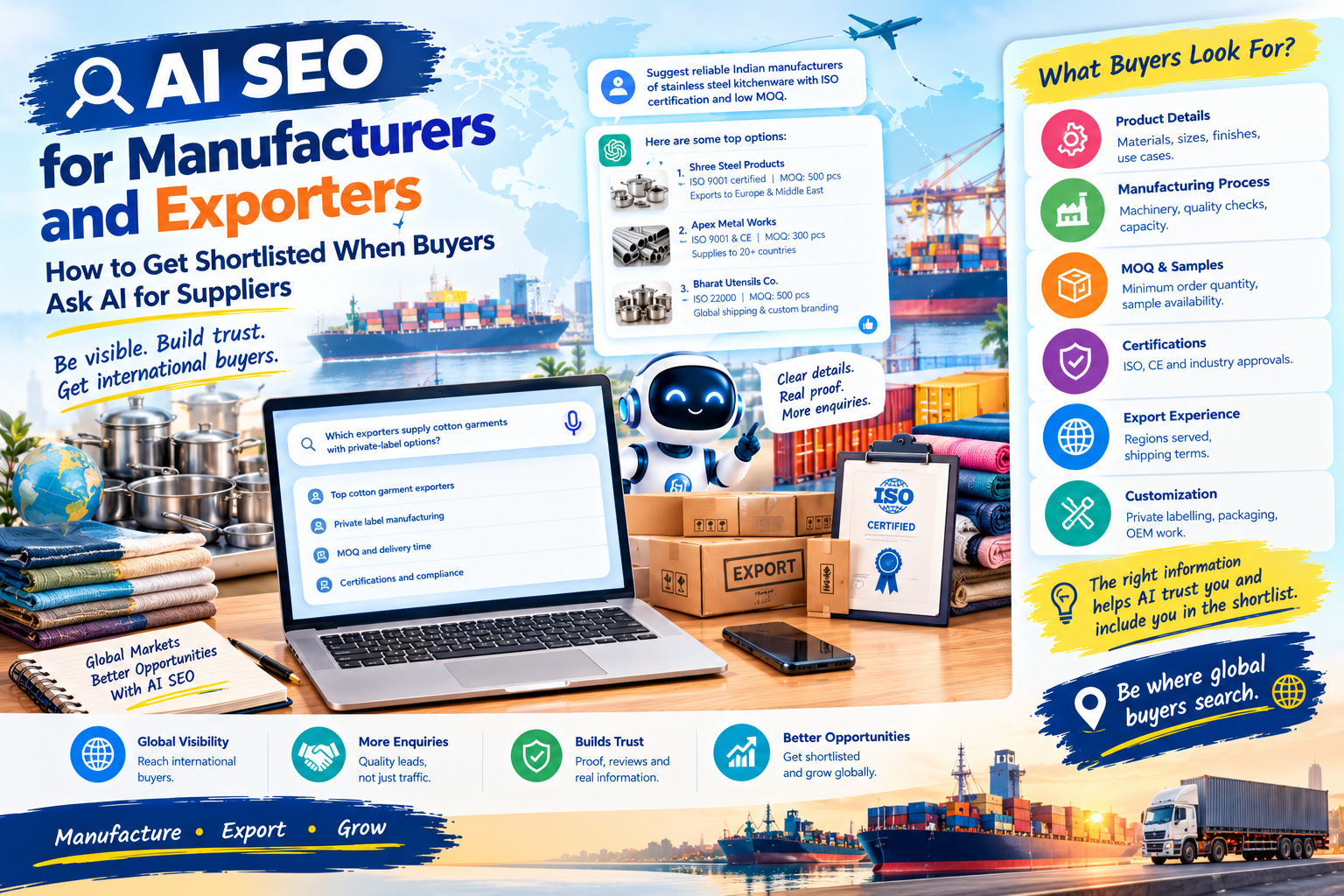
A procurement manager in Germany types, “Suggest reliable Indian manufacturers of stainless steel kitchenware with ISO certification and low minimum order quantities.” A buyer in Dubai asks, “Which exporters supply cotton garments with private-label options?” The AI replies with a short list of suppliers and the reasons behind each pick.
For manufacturers and exporters, this is a new kind of shortlist. Sourcing used to depend on trade fairs, directories and referrals. Now AI is becoming a first filter. Here are the questions we hear most about AI SEO for B2B suppliers.
Why does AI SEO matter for manufacturers and exporters?
B2B buyers research heavily before they ever send an enquiry. They compare capabilities, certifications, capacity, pricing models and delivery reliability. AI assistants speed up that comparison by summarizing options in seconds.
If your website only says “quality products at best price,” the AI has nothing concrete to repeat. Suppliers who publish clear, verifiable details give AI the material it needs to include them.
What information do buyers and AI tools look for?
Buyers think in specifications and risk. Your website should answer these questions in plain, readable text:
- What you make, with product categories, materials, sizes and finishes.
- How you make it, including processes, machinery and quality checks.
- Capacity, such as monthly output and typical lead times.
- Minimum order quantity and whether samples are available.
- Certifications, such as ISO, CE or industry-specific approvals.
- Export experience, including regions served and shipping terms.
- Customization, like private labelling, custom packaging or OEM work.
Keep this in real text, not locked inside PDF catalogues or product images. At Sarkar SEO, we often find that a supplier’s strongest details sit in downloadable brochures that AI tools struggle to read.
How should I structure product pages for B2B buyers?
Treat each product page as a mini spec sheet that also answers common questions:
- A clear product name and short description of use cases.
- A specification table with dimensions, materials, tolerances and standards.
- Packaging, MOQ, lead time and payment terms.
- Photos of the real product and production, not only stock images.
- A short FAQ, such as “Can you customize the size?” or “What documents do you provide for export?”
Specific beats generic. “304-grade stainless steel, available in 18 to 32 cm, 500-piece MOQ” is far more useful than “high-quality steel products.”
How do certifications and proof build trust?
Trust is the main barrier in international sourcing. Buyers worry about quality, delivery and fraud, so proof matters a lot.
Publish your certifications clearly, with certificate numbers and issuing bodies where you’re allowed to share them. Add factory photos, audit summaries, client logos (with permission) and case studies that describe a real order: the buyer’s need, your solution, the delivery timeline and the outcome. Only claim what you can document. Overstated claims damage credibility with both buyers and AI systems.
How do I get mentioned on third-party sites?
AI tools learn from more than your own website. Directories, trade portals, industry associations, export councils, trade publications and buyer reviews all shape how your company is described.
Make sure your profiles on respected B2B platforms and industry bodies are complete and consistent: same company name, address, product categories and contact details. Seek mentions in relevant trade media and exhibitor listings. Quality and relevance beat quantity. A few credible, industry-specific mentions usually do more than dozens of generic directory links.
Should I create content beyond product pages?
Yes. Buyers ask educational questions early in their research, and AI loves clear explanations. Useful content includes:
- Buying guides, such as “How to choose a stainless steel cookware supplier.”
- Process explainers, showing how your product is made and tested.
- Compliance guides, covering export documentation, standards and labelling.
- Comparison pages, like materials, grades or manufacturing methods.
- Logistics FAQs, about shipping terms, packaging and typical timelines.
Write for a busy professional. Start each section with the answer, then explain. This is where Answer Engine Optimization and Generative Engine Optimization overlap: clear answers help AI quote you, and consistent signals help AI trust you.
What about multilingual and regional queries?
International buyers may search in English, but many also use Arabic, Spanish, French, German or other languages. If you serve those markets seriously, consider translating your key pages with proper human review, not just machine output. Mention the regions you serve and the standards that apply there.
Also keep currency, units and shipping terms clear. A buyer in the US thinks in inches and pounds, while one in Europe expects metric. Small details like this build confidence.
What technical basics should I fix?
- Crawl access. Make sure your robots.txt and security settings aren’t blocking legitimate bots.
- Schema markup. Use Organization, Product and FAQ schema where suitable.
- Fast loading. Compress images and test on slower international connections.
- Clean structure. Use clear headings, short paragraphs and tables.
- Working contact paths. An enquiry form, WhatsApp number and email that actually get answered.
How can I check whether AI recommends my company?
Run a monthly test:
- Write 20 to 30 buyer-style questions covering product, material, certification, region and MOQ.
- Ask them in ChatGPT, Gemini and Perplexity.
- Record which suppliers appear and how they’re described.
- Note which sources are cited, and fix the weakest areas first.
AI answers vary between runs, so repeat each question and watch the trend. Sarkar SEO builds this kind of tracking into client reports so progress is based on real answers.
What mistakes should suppliers avoid?
- Vague claims like “best quality” with no evidence.
- Catalogues only in PDF or image form.
- Inconsistent company details across portals.
- Outdated certifications or expired listings.
- Ignoring enquiries, which wastes the visibility you earn.
Where should I begin?
Choose your top three products. Rewrite each page with specifications, MOQ, lead time and a short FAQ. Gather certifications and real factory photos, align your profiles on major B2B platforms and publish one buying guide. Then run your question list to set a baseline. If you’d like expert support, Sarkar SEO can audit how AI currently describes your company and map the next steps.
