



A mention and a citation sound like the same thing. They aren’t, and treating them as one number is the fastest way to misread your AI SEO results.
This guide explains the difference, which metrics are worth tracking, how to choose between manual checks and tools, and how to report progress without overpromising.
What’s the difference between a mention and a citation?
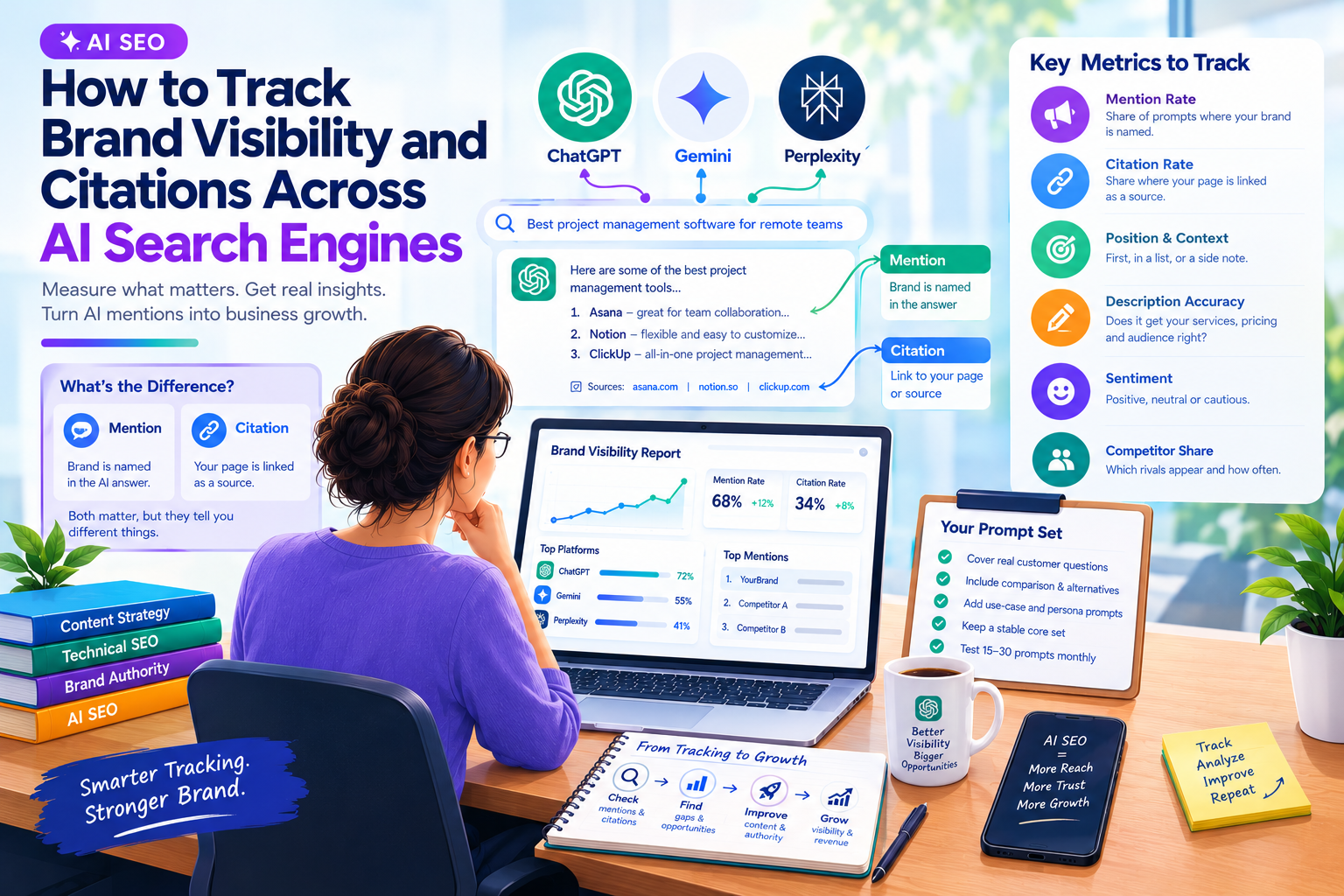
A mention is when an AI answer names your brand in its text. A citation is when the answer links to or lists your page as a source.
You can have one without the other. A model might recommend your company from what it learned in training, with no link at all. Or it might cite your blog post while naming a competitor in the recommendation itself. Both matter, but they tell you different things: mentions reflect brand reputation, citations reflect content usefulness.
Which metrics are actually worth tracking?
Keep the list short and meaningful:
- Mention rate: the share of your test prompts where your brand is named.
- Citation rate: the share where one of your pages is linked as a source.
- Position and context: whether you appear first, in a list, or as a side note.
- Description accuracy: whether the AI describes your services, pricing and audience correctly.
- Sentiment: whether the framing is positive, neutral or cautious.
- Competitor share: which rivals appear alongside you, and how often.
Clicks from AI platforms are worth watching too, but they only capture part of the picture, since many AI answers are read without any click.
How do I build a prompt set that gives reliable data?
Your prompt list is your measuring stick, so build it carefully:
- Collect real questions from sales calls, support tickets and search data.
- Cover the funnel: educational prompts, comparison prompts, and “best for [use case]” buying prompts.
- Include variations: location, budget and company-size modifiers.
- Freeze the list. Add new prompts over time, but keep a core set unchanged so months stay comparable.
Fifteen to thirty well-chosen prompts beat a hundred random ones.
Should I track manually or use a tool?
Both have a place.
Manual tracking is free and teaches you a lot. You see the actual wording, the sources and the tone. It becomes tedious past a few dozen prompts, and results vary between runs.
Dedicated tracking tools automate repeated prompt runs across platforms and store history. The category is young and changing fast, so evaluate them carefully: check which platforms they cover, how they handle answer variation, and whether you can export the raw responses.
A sensible path is to start manually, learn what matters to your business, then automate once your prompt set is stable.
Why do AI answers change between runs?
Language models generate answers, they don’t retrieve fixed rankings. Wording, context, personalization and live search results can all shift the output. That’s why a single screenshot is weak evidence.
To handle this, run each prompt more than once when possible, record the date and platform, and judge by the trend across weeks and months. At Sarkar SEO, we report ranges and patterns, not single lucky outputs.
How do I track citations specifically?
For citations, look at the source list that platforms like Perplexity and ChatGPT’s search mode display. Note:
- Which of your pages get cited, and for which prompts
- Which competitor pages are cited instead
- Which third-party sites (review platforms, publications, forums) are cited most in your category
That last point is gold. If the same few outside sites keep appearing as sources, those are the places worth earning coverage.
How do I connect AI visibility to business results?
Be realistic. Attribution is imperfect, because many buyers ask an AI tool, then later search your brand name directly or type your URL. Useful indirect signals include:
- Growth in branded search over time
- A “how did you hear about us?” field with an AI option
- Direct and referral traffic from AI platforms
- Sales conversations where prospects mention what an AI tool told them
None of these is perfect alone, but together they build a credible story.
What should a monthly report include?
Keep it simple and honest:
- Mention and citation rates versus last month
- A few example answers, with dates and prompts
- Notable changes in how your brand is described
- Competitor movement
- What was changed on the site or off-site, and what to do next
Sarkar SEO keeps client reports in this format so each result connects to an action, rather than being a dashboard of numbers without context.
What mistakes should I avoid?
- Celebrating one good screenshot
- Changing the prompt set every month
- Ignoring inaccurate descriptions, which can hurt conversions quietly
- Measuring only the platform where you do well
- Promising stakeholders a guaranteed placement
The bottom line
Good tracking separates mentions from citations, uses a stable prompt set, accepts that answers vary, and reports trends with context.
If you want a clean baseline of where your brand stands today, Sarkar SEO can set up a structured prompt audit and show you where to focus first.
