



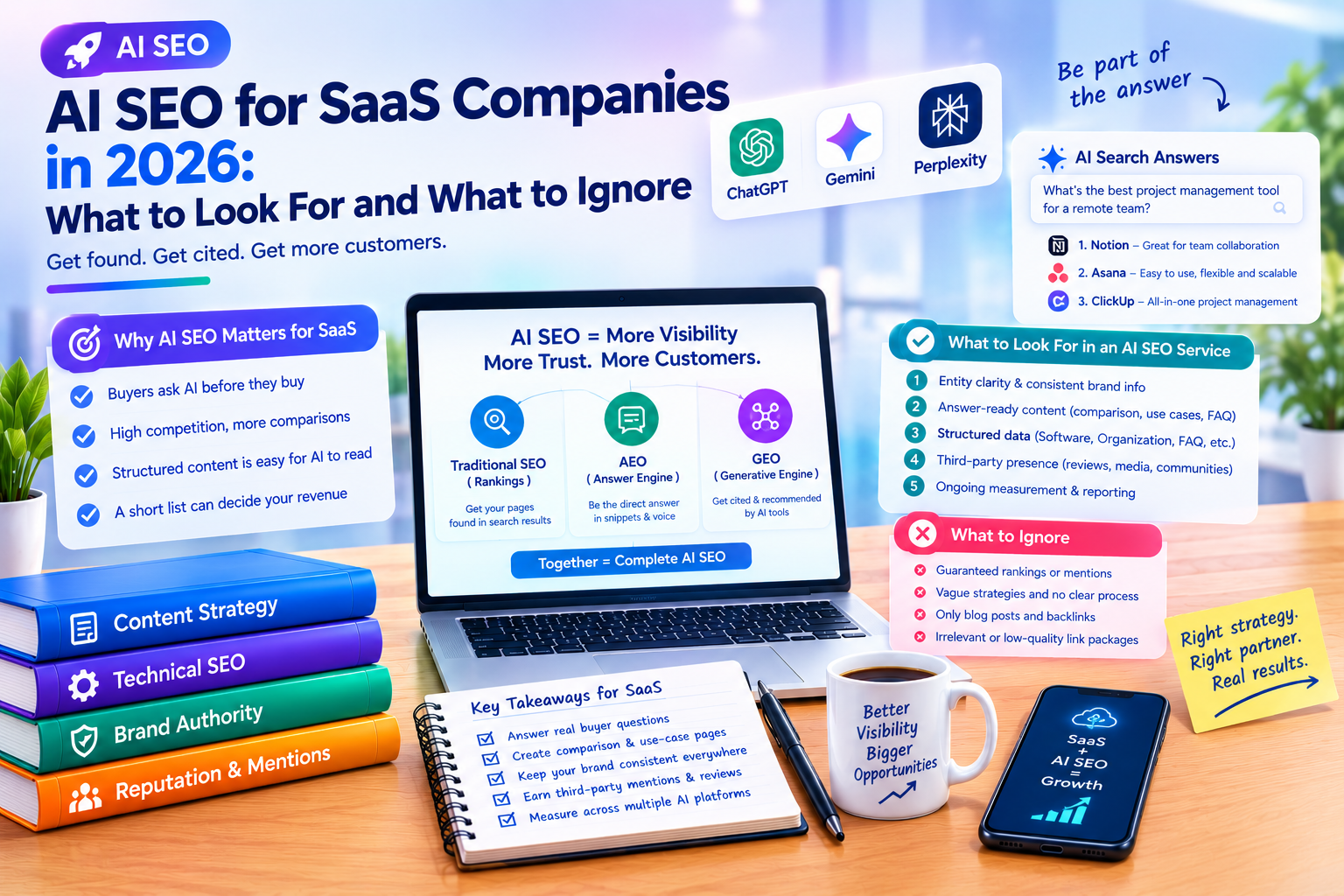
Software buyers have changed how they research. Before booking a demo, many now ask ChatGPT, Gemini or Perplexity something like “what’s the best project management tool for a remote agency?” and shortlist whatever the answer names. If your SaaS product isn’t in that answer, you lose the lead before your sales team knows it existed.
This is where AI SEO comes in for SaaS companies. Here are the questions founders and marketing heads ask us most often.
Why does AI SEO matter more for SaaS than for other industries?
SaaS is a crowded, comparison-heavy market. Buyers constantly ask “X vs Y,” “best tool for Z” and “alternatives to [competitor],” which are exactly the questions AI assistants answer in a single paragraph. A short list of two or three recommended tools can take most of the attention.
SaaS content is also unusually well suited to AI retrieval. Pricing pages, feature pages, documentation and integration lists are structured and factual, so AI systems can read them easily. The opportunity is real, but so is the risk of being left out.
What is the difference between AI SEO, GEO and AEO for a software company?
The terms overlap, but each solves a different problem:
- Traditional SEO gets your pages ranking for category and feature searches.
- AEO (Answer Engine Optimization) structures your content so it can be pulled directly as a short, accurate answer, such as “What does [your product] do?” or “How much does it cost?”
- GEO (Generative Engine Optimization) builds the wider reputation signals that make AI tools comfortable recommending you by name.
For SaaS, the practical split is simple. AEO fixes how your own pages read, and GEO fixes how the rest of the internet describes you. You need both.
What should a good AI SEO service for SaaS actually include?
A credible service should cover these areas:
- Entity clarity. Your product name, category, audience and core use case should be stated the same way on your site, profiles and press mentions.
- Answer-ready content. Comparison pages, use-case pages, integration pages and a thorough FAQ, all written in plain language.
- Structured data. Software Application, Organization, FAQ and Review schema where appropriate.
- Third-party presence. Honest mentions on review platforms, industry publications, communities and partner sites.
- Measurement. A repeatable way to check how your brand appears across AI tools over time.
Teams like ours at Sarkar SEO approach it in this order: fix the foundation, build the content, then widen the reputation footprint. Skipping straight to outreach without the first two steps is a common and expensive mistake.
How do I evaluate an AI SEO agency without getting burned?
Be cautious of anyone who guarantees a specific position in ChatGPT. AI answers vary by prompt, by user, by platform and even by day, so a fixed guarantee isn’t realistic. Instead, ask:
- Can they show before-and-after examples with clear methodology?
- Do they explain what they’ll change, rather than hiding it behind jargon?
- Do they track more than one AI platform?
- Do they treat AI SEO as an extension of SEO, not a replacement for it?
A good partner will be open about what is known, what is uncertain and what is simply being tested.
What content do SaaS brands need to get recommended?
Think about the questions a buyer asks at each stage:
- Awareness: “What is [category] software?”
- Consideration: “[Your product] vs [competitor],” “best [category] tools for [audience].”
- Decision: “Does [your product] integrate with [tool]?” “What does it cost?”
Create one clear, honest page for each of these. Put the direct answer near the top, then support it with specifics: features, limits, pricing tiers and ideal customer. Pages that admit who the product is not for often earn more trust, from readers and from AI systems alike.
Do reviews and mentions outside my website really matter?
Yes. AI tools don’t rely on your homepage alone. They draw on what other sources say about you, including review sites, comparison articles, forums and expert roundups. If your brand is described inconsistently or barely mentioned elsewhere, the model has little to work with.
Encourage genuine reviews, contribute expert commentary to industry publications and keep your third-party profiles accurate. Authentic, specific mentions beat large volumes of generic ones.
How should I think about Google AI Overviews and Perplexity?
Treat them as two ends of the same spectrum. Google AI Overviews tend to reward pages that already satisfy search intent well, with complete coverage, clean structure and strong page experience. Perplexity relies heavily on live web sources and displays its citations, so fresh, well-sourced pages have a good chance of being referenced.
The same habits help on both: answer questions directly, cite your sources, keep information current and make your pages easy to read.
How long until a SaaS brand sees results?
Technical and content improvements can show movement within weeks. Building a consistent third-party footprint usually takes a few months. Because AI answers fluctuate, judge progress by trends across many prompts, not by a single screenshot.
