



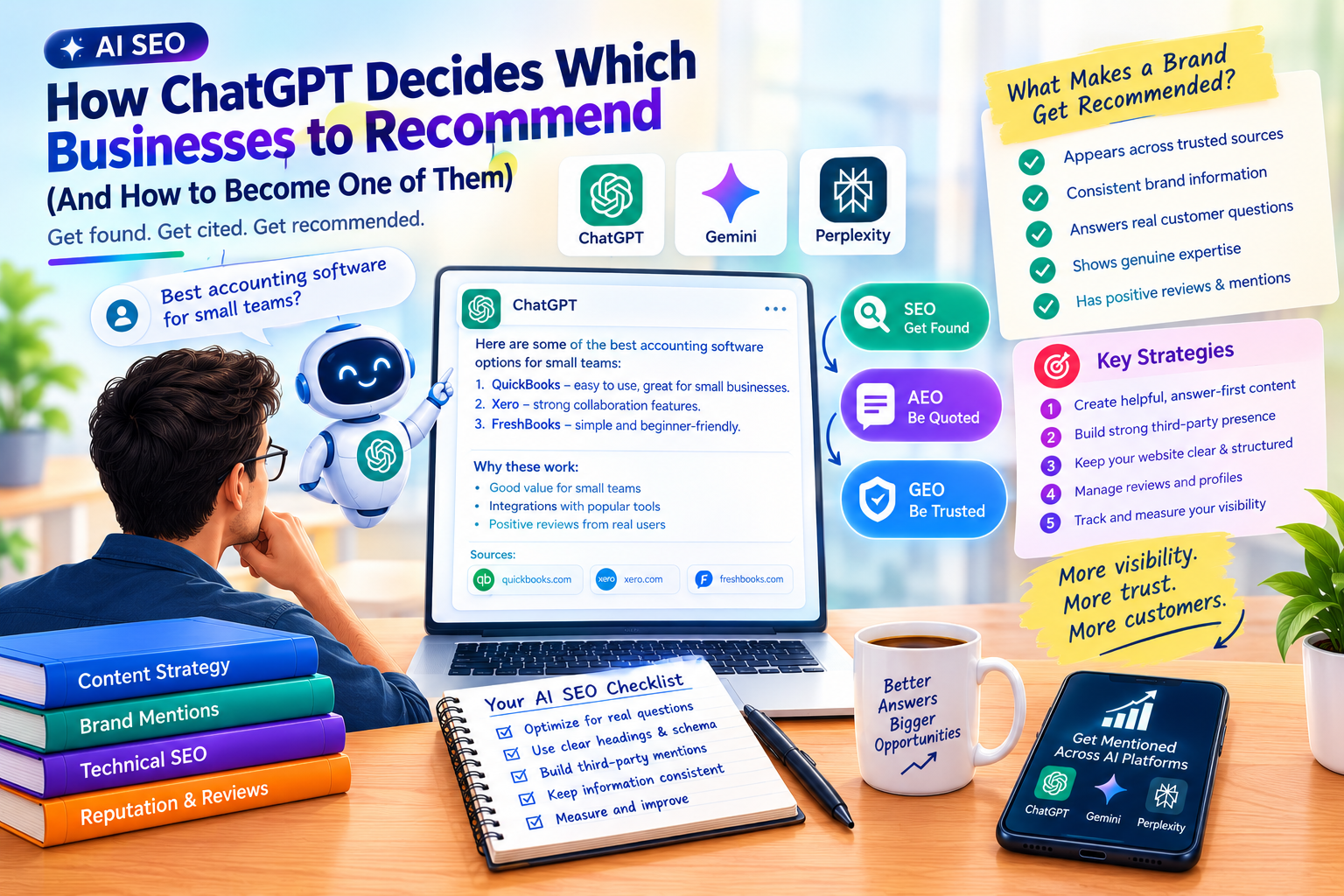
Ask ChatGPT for “the best accounting software for small teams” and you won’t get ten blue links. You’ll get a short list of names, each with a reason attached. If your business isn’t on that list, the customer may never find you. That is why AI SEO has moved from a side experiment to a core marketing priority. At Sarkar SEO, we see this shift in almost every client conversation: people no longer ask “how do I rank first?” They ask “how do I get named?”
Below are the questions we hear most often, answered plainly.
What is AI SEO, and how is it different from traditional SEO?
Traditional SEO helps your pages rank in a list of results. AI SEO helps your brand get understood, trusted and quoted inside the answer itself. The goal changes from earning a click to earning a mention.
You still need a fast, crawlable, well-structured website. But AI systems also weigh how consistently your brand is described across the web, how clearly your content answers real questions, and whether credible sources back you up.
What is the difference between GEO, SEO and AEO?
The three terms overlap, but each has a different job:
- SEO earns rankings in classic search results.
- AEO (Answer Engine Optimization) formats your content so it can be lifted directly as an answer, such as featured snippets, voice replies and AI summaries.
- GEO (Generative Engine Optimization) builds the authority and entity signals that make generative tools like ChatGPT, Gemini and Perplexity cite or recommend your brand.
Think of SEO as getting found, AEO as being quotable, and GEO as being trusted enough to be recommended. A strong AI SEO plan uses all three.
How does ChatGPT choose which businesses to recommend?
Nobody outside the AI labs knows the exact formula, and anyone who claims otherwise is guessing. What we can observe is a clear pattern. Recommendations tend to favor brands that:
- Appear repeatedly across independent, credible sources.
- Are described consistently, with the same name, category and strengths everywhere.
- Have content that directly answers the way people phrase their questions.
- Show real expertise, with named authors, original data and specific details.
In short, AI tools lean toward brands that look established and are easy to summarize. Vague marketing language gets skipped. Clear, specific language gets used.
How do I optimize my website for ChatGPT search?
Start with the basics that make your content easy to understand and retrieve:
- Answer first. Put the direct answer in the first two sentences under each heading, then add detail.
- Use real questions as headings. Write them the way a customer would type them.
- Add schema markup. Organization, FAQ, Product and Local Business schema help machines read your page accurately.
- Keep facts current. Pricing, services, locations and dates should be accurate and recently updated.
- Show your people. Author bios and visible credentials build trust for readers and machines alike.
This is the groundwork we put in place first when a client joins Sarkar SEO, because every other tactic works better on top of it.
How can I get my brand mentioned in ChatGPT, Gemini and Perplexity?
Mentions come from presence. The more places a trustworthy description of your brand exists, the more confident an AI model becomes about repeating it. Focus on:
- Expert commentary and guest articles on respected industry sites.
- Genuine participation in communities where your customers ask questions.
- Reviews and third-party profiles that describe you accurately.
- Original research or data that other people want to cite.
Each platform behaves a little differently. Perplexity leans heavily on live web sources and shows its citations openly, so fresh, well-sourced pages matter a lot there. Gemini draws on Google’s ecosystem, so a healthy Google presence helps. ChatGPT’s answers vary with the query and whether it is browsing the web at that moment.
Does link building still help AI search visibility?
Yes, but the emphasis has shifted from quantity to context. A link or mention from a respected, relevant publication does two jobs: it passes traditional authority, and it reinforces your brand’s place in a topic area. Dozens of low-quality links do neither.
There’s no widely accepted proof that any specific link type directly drives AI recommendations, so be wary of guarantees. Our view is simple: treat links as one part of a wider reputation-building effort, not a standalone trick.
How do I improve my visibility in Google AI Overviews?
Google’s AI Overviews pull from pages that already satisfy search intent well. To improve your odds:
- Cover a topic completely, including the follow-up questions people ask next.
- Use clear structure: short paragraphs, descriptive subheadings, and lists or tables where they help.
- Support claims with sources and first-hand experience.
- Maintain strong page experience, since fast, mobile-friendly pages are still the foundation.
Pages that already earn featured snippets are often good candidates, which is another reason AEO and SEO work together.
How long does it take to see results?
Expect gradual progress rather than overnight wins. Technical fixes and content restructuring can show an effect within weeks. Building a consistent brand presence across the web usually takes a few months. AI answers can also change from one day to the next, so measure trends over time rather than reacting to a single response.
