



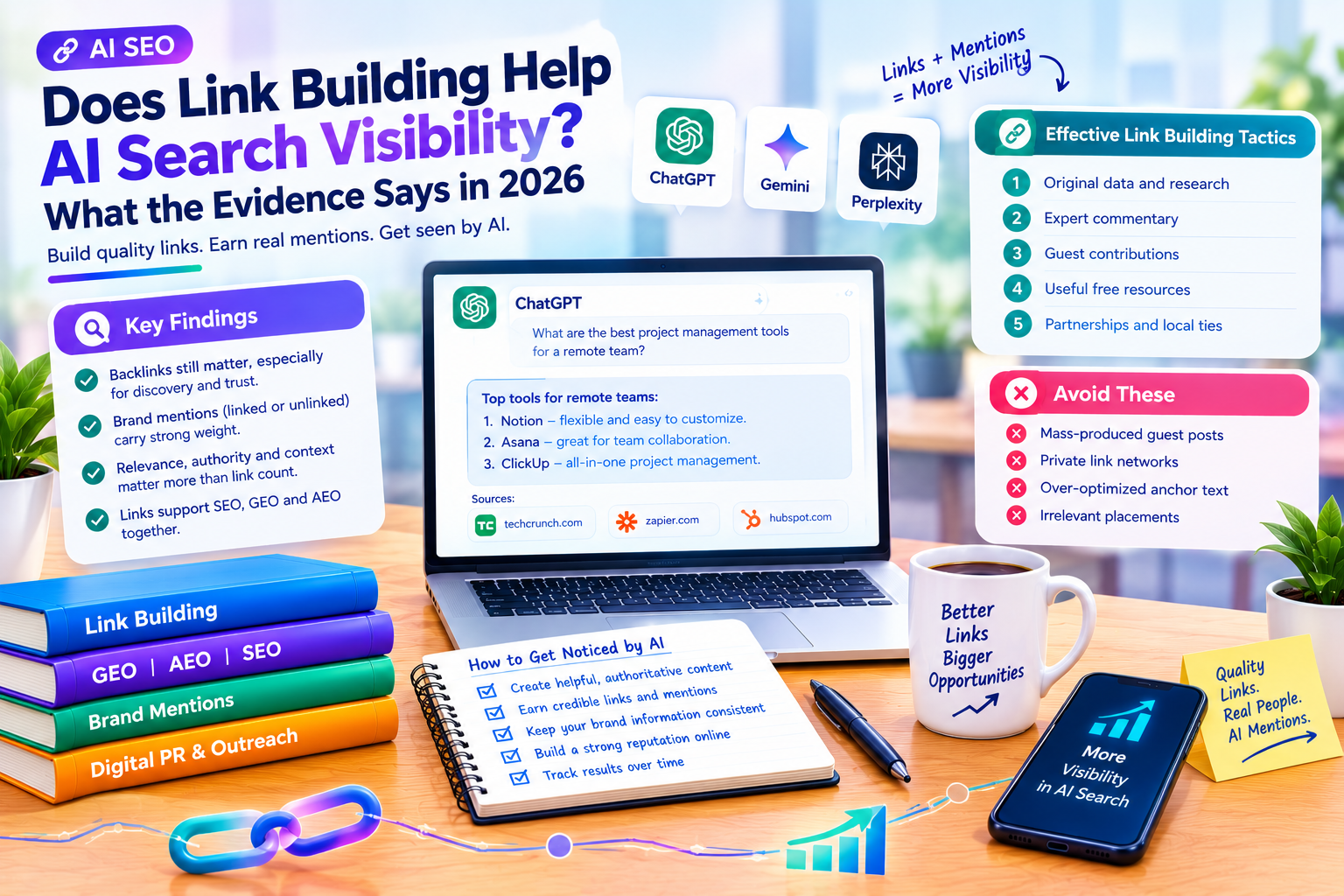
Link building has been the backbone of SEO for twenty years. Now that people get answers from ChatGPT, Gemini and Perplexity, a fair question follows: do links still matter when an AI writes the answer instead of listing ten websites?
The honest answer is “yes, but not in the way most people assume.” Here are the questions we hear most often as AI SEO becomes part of everyday marketing.
Do backlinks still matter for AI search visibility?
Yes, indirectly. Backlinks remain a strong signal in traditional search, and many AI tools lean on search indexes to find and verify information. Google’s AI Overviews are built on top of Google Search, and Perplexity and ChatGPT’s browsing features retrieve live web pages. Pages that rank well and are widely referenced are more likely to be retrieved in the first place.
What nobody has shown is a clean, direct formula such as “ten links equals one ChatGPT mention.” Treat anyone who claims that with caution. The evidence supports a looser conclusion: links help you get discovered and trusted, and discovery and trust feed AI visibility.
What matters more than the number of links?
Context and credibility. A single mention on a respected industry publication tells both search engines and AI systems something valuable: a trusted source considers your brand relevant to this topic. Fifty links from unrelated, low-quality sites say very little.
Three things carry the most weight:
- Relevance. The linking page should sit in your industry or a closely related one.
- Authority. The source should be one that real readers, journalists and customers trust.
- Surrounding text. How the page describes you matters. A sentence explaining what you do is worth more than a bare link in a footer.
What about unlinked brand mentions?
They count more than many marketers expect. AI models learn from language, not only from link graphs. When your brand is repeatedly described in articles, forums, reviews and interviews, with or without a clickable link, the model builds a stronger picture of who you are and what you’re known for.
This is why modern link building and digital PR are blending together. At Sarkar SEO, we think of the goal as earning mentions that carry meaning, with links as a welcome bonus rather than the only target.
How does link building connect to GEO and AEO?
Each discipline plays a different role:
- SEO uses links to earn rankings.
- GEO (Generative Engine Optimization) uses credible third-party mentions to build the authority that makes AI tools comfortable recommending you.
- AEO (Answer Engine Optimization) makes your own pages easy to quote, so that once an AI finds you, it has a clear answer to use.
Links sit mostly in the GEO camp, but they support all three. A well-structured page with no external validation is easy to read but easy to overlook. A heavily linked page that is poorly structured gets found but is hard to quote. You want both.
Which link-building tactics are worth the effort now?
Focus on approaches that produce genuine editorial value:
- Original data and research. Surveys, benchmarks and first-party statistics give other writers a reason to cite you.
- Expert commentary. Responding to journalist and industry requests places your name next to a clear opinion on a relevant topic.
- Guest contributions. Thoughtful articles on respected sites, written for readers rather than for search engines.
- Useful free resources. Templates, calculators and guides that people naturally reference.
- Partnerships and local ties. Associations, sponsorships and community pages, especially valuable for local businesses.
Each of these earns links as a side effect of being useful, which is exactly what keeps them durable.
Are there link-building practices that can hurt?
Yes. Be wary of:
- Mass-produced guest posts on sites that publish anything for a fee.
- Private networks built only to pass authority. Search engines have a long record of discounting or penalizing these.
- Over-optimized anchor text repeated across many sites.
- Irrelevant placements that have nothing to do with your business.
Beyond the ranking risk, thin or spammy placements add noise to the information AI tools collect about you. If a low-quality site describes your brand inaccurately, that description can linger. Quality control matters more than volume.
How can I tell if my links are helping AI visibility?
Look for patterns instead of single results:
- Track referring domains and the quality of new mentions.
- Maintain a fixed list of questions customers ask, and test them on ChatGPT, Gemini, Perplexity and Google every few weeks.
- Note whether your brand is mentioned, cited or recommended, and which sources appear alongside it.
- Compare changes against your link and PR activity over several months.
Because AI answers shift by platform, wording and timing, a trend over time is far more reliable than one screenshot.
Should I stop link building and focus only on content?
No. Strong content without external validation struggles to stand out, and external validation without strong content has little to point to. Think of them as a pair. Publish pages that answer real questions clearly, then earn credible references that confirm you’re a source worth trusting.
