



Search used to be a race for position one. Today, a growing share of people never reach a results page at all. They ask a question and read the answer an AI gives them. Whoever supplies that answer earns the attention, and often the sale.
That is the idea behind Answer Engine Optimization (AEO), a key part of any serious AI SEO plan. At Sarkar SEO, AEO is one of the first things we review when a business asks why competitors keep getting named and it doesn’t. Here are the questions we hear most, with straight answers.
What is Answer Engine Optimization, in simple terms?
AEO is the practice of shaping your content so that search engines and AI assistants can pull a clear, correct answer straight from your pages. It covers featured snippets, voice replies, Google AI Overviews and the answers inside tools like ChatGPT and Perplexity.
Traditional SEO asks, “Can my page rank?” AEO asks, “Can my page be the answer?” The second question demands clearer writing, tighter structure and more precise facts.
How is AEO different from GEO?
They are close cousins, and people mix them up. A simple way to separate them:
- AEO is about format and clarity on your own pages, so answers are easy to extract.
- GEO (Generative Engine Optimization) is about authority and reputation across the wider web, so AI tools trust your brand enough to recommend it.
AEO makes you quotable. GEO makes you credible. When both are in place, your odds improve noticeably. When only one is, results tend to be patchy.
Which AEO strategies work best for businesses in 2026?
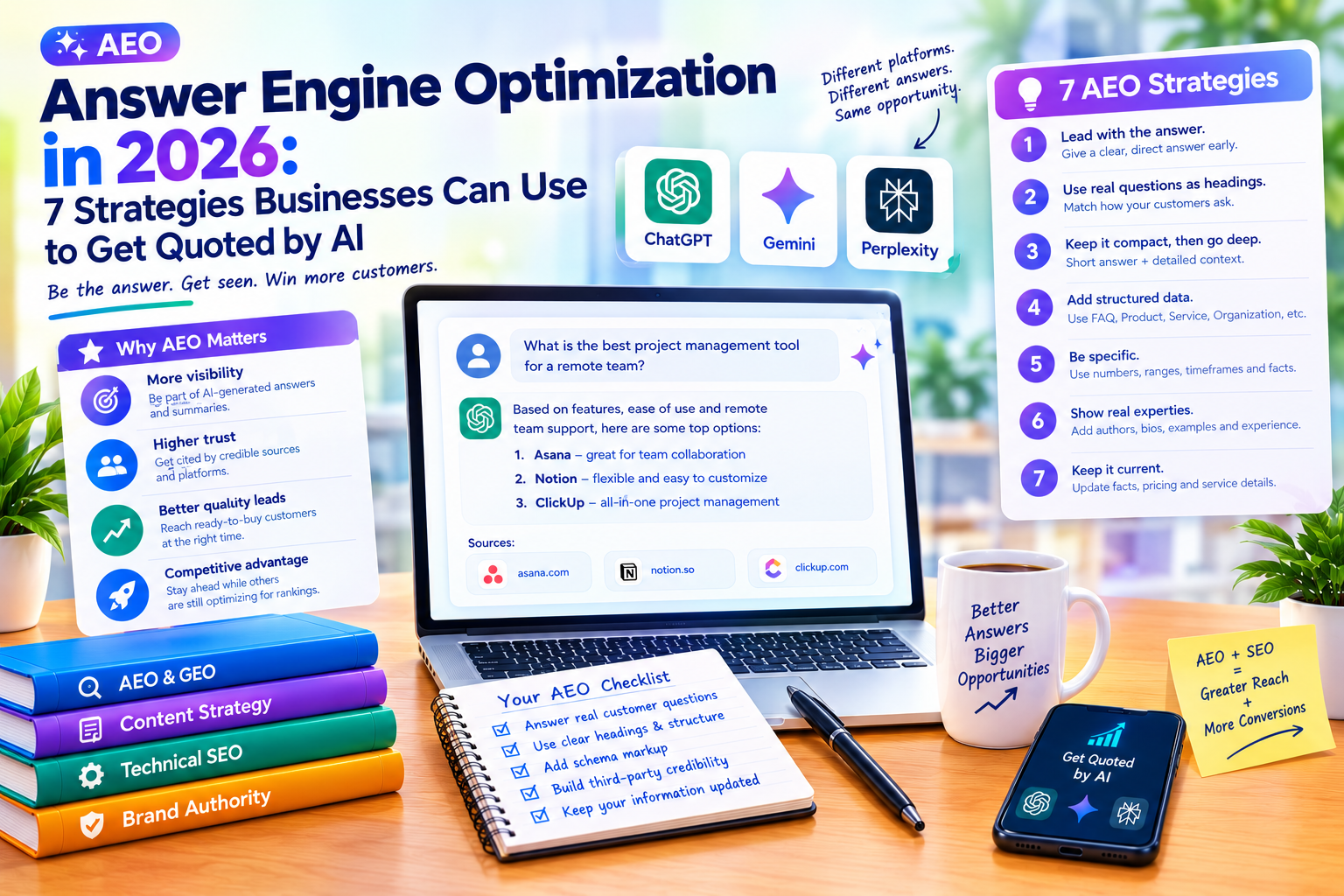
These seven consistently make a difference.
- Lead with the answer. Put a direct, plain-language answer in the first one or two sentences under every heading. Add context afterward, not before.
- Write headings as real questions. Use the phrasing customers actually type or speak, such as “How much does a kitchen remodel cost in Jaipur?” rather than “Pricing overview.”
- Keep answers compact, then go deep. A short, quotable answer followed by a fuller explanation serves both quick readers and AI systems.
- Add structured data. FAQ, Organization, Product, Service and Local Business schema help machines read your page without guessing.
- Be specific. Numbers, ranges, timeframes, names and conditions make an answer useful. Vague claims like “we offer great value” give an AI nothing to repeat.
- Show real expertise. Named authors, short bios, original examples and first-hand experience signal that a real person stands behind the content.
- Keep it current. Outdated pricing, old statistics and stale service details reduce trust. Review your key pages on a regular schedule.
What kind of content gets picked up as an answer?
Content that resolves a question quickly and completely. Good candidates include:
- Definition pages (“What is [your service]?”)
- Step-by-step guides
- Comparison pages (“X vs Y”)
- Pricing and cost explainers
- Frequently asked questions written in a natural voice
A useful test: if someone copied only the first paragraph under your heading, would it still make sense on its own? If yes, you’re writing in AEO style.
Does AEO matter for local and service businesses?
Very much so. People increasingly ask AI assistants things like “best dentist near me” or “who can fix this today?” For these queries, your Google Business Profile, reviews, location pages and consistent business details (name, address, phone) all feed the answer.
Make sure your information matches everywhere it appears. Inconsistent details confuse both customers and machines. Add local FAQs that mention your service area, working hours and common customer concerns.
How do I know if my AEO efforts are working?
Don’t rely on one screenshot of one AI response. Answers vary by platform, wording and even time of day. A steadier approach:
- Keep a fixed list of 20 to 30 questions your customers really ask.
- Test them on ChatGPT, Gemini, Perplexity and Google at regular intervals.
- Note whether your brand is mentioned, cited or recommended.
- Track trends over weeks and months, and pair them with normal analytics such as impressions, branded searches and leads.
This gives you honest direction without chasing noise.
What mistakes should I avoid?
The most common ones we see:
- Stuffing keywords. AI systems read meaning, not density. Natural language wins.
- Hiding the answer. Long introductions bury the part everyone wants.
- Copying competitors. Duplicated phrasing adds nothing worth citing.
- Ignoring off-site signals. Strong pages help, but mentions on trusted external sites strengthen the case.
- Expecting guarantees. No one can promise a fixed spot inside an AI answer. Be careful with anyone who does.
Is AEO replacing SEO?
No. AEO builds on SEO. Crawlable pages, fast loading, sensible site structure and quality content are still the foundation. AEO simply adds a layer that makes your content easier to extract and quote. Think of it as upgrading your SEO for a world where answers matter as much as rankings.
