



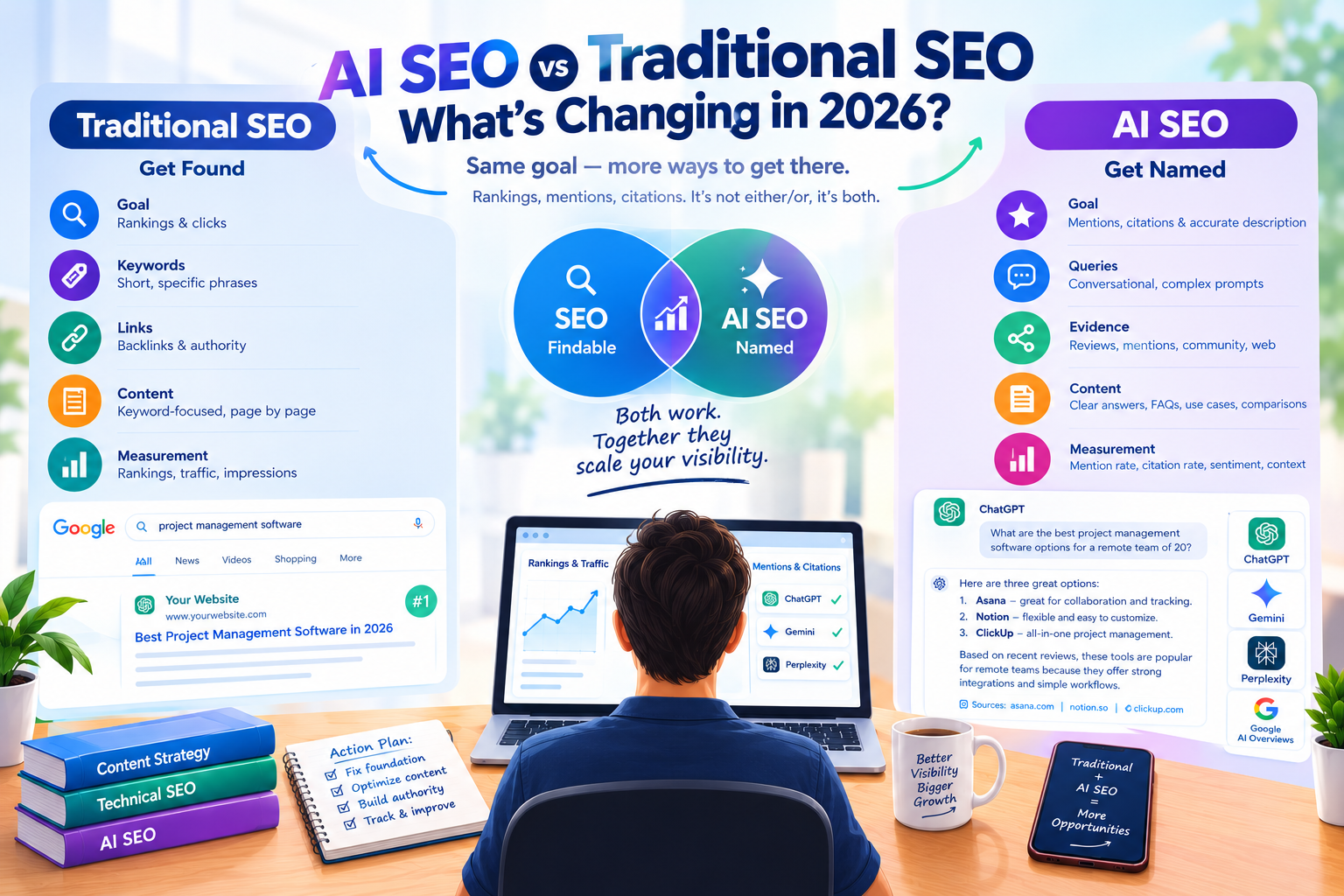
Every few years, someone declares SEO dead. It hasn’t died, but 2026 is the year it visibly changed shape. Search results now include AI summaries, chat tools answer buying questions directly, and visibility increasingly means being named, not just ranked.
This guide cuts through the noise: what’s genuinely different, what hasn’t moved, and what to start, stop and keep doing.
Is traditional SEO still relevant in 2026?
Yes. Crawlable sites, relevant content, good user experience and credible links still underpin visibility, including in AI tools that search the live web. AI SEO builds on those fundamentals rather than replacing them.
What has changed is what sits on top of them.
What’s actually different about AI SEO?
Four shifts stand out:
- The goal. Traditional SEO chases rankings and clicks. AI SEO aims to be named, cited and accurately described inside generated answers.
- The query. People now type full, conversational prompts with context, such as “best accounting software for a freelance designer in India,” not short keywords.
- The evidence. Models lean on a brand’s wider footprint, including reviews, editorial mentions and community discussions, not just its own pages.
- The scoreboard. Rankings are replaced or supplemented by mention rates, citation rates and description accuracy.
What hasn’t changed?
- Quality content that genuinely helps people still wins.
- Technical health still matters, since broken or slow sites are harder to read.
- Trust and reputation still count, probably more than before.
- Shortcuts still backfire over time.
If your fundamentals are weak, fix them first. Adding AI SEO tactics on top of a shaky base rarely pays off.
How does keyword strategy change?
Keywords don’t vanish, but intent clusters matter more. Instead of targeting a single phrase, think in terms of the full set of questions a buyer might ask about a problem, and answer them clearly in one place.
That means more question-style headings, FAQ sections, comparison pages and use-case pages, all written in natural language.
How does link building change?
Links still carry signals, but the broader idea is mentions and corroboration. A relevant article that names your brand, even without a link, can support how AI systems understand you. Focus on relevance and credibility over raw volume. Low-quality placements are a poor investment in either world.
How should content be written differently?
Write for the skimmer and the machine at once:
- Lead with the answer
- Use short, self-contained paragraphs
- Define key terms plainly
- Add original examples, data or experience
- Show authorship and update dates
Sarkar SEO often tells clients that if a paragraph still makes sense when copied out of the page, it’s ready for AI-driven discovery.
How does reporting change?
Traditional dashboards, such as rankings, impressions and sessions, remain useful. Add a second layer: a fixed set of customer-style prompts tested monthly across ChatGPT, Gemini, Perplexity and Google AI Overviews, tracking whether you’re named, cited and described correctly.
Expect some clicks to disappear as answers get resolved on the results page. That’s a reason to measure visibility as well as traffic, not to panic.
What should I stop doing?
- Publishing thin, keyword-stuffed articles
- Buying mass-produced links or fake reviews
- Judging success only by rankings and clicks
- Hiding key information in PDFs or heavy scripts
- Letting key pages go stale
What should I start doing?
- Rebuild your top pages with clear answers and FAQs
- Define one consistent brand description across the web
- Earn credible, relevant third-party mentions
- Collect detailed customer reviews
- Test real prompts monthly and act on gaps
What should I keep doing?
Keep the SEO basics running: technical audits, internal linking, helpful content and a good user experience. At Sarkar SEO, we treat AI SEO as an extra layer on a healthy base, never a replacement for one.
Will AI replace SEO completely?
Nobody can say for certain, and confident predictions in either direction deserve skepticism. The practical stance is to prepare for both: stay findable in traditional search while building the clarity and credibility that AI systems reward.
The bottom line
Traditional SEO gets you found. AI SEO gets you named. In 2026, you need both, measured honestly and built on genuine quality.
If you’re unsure where your brand stands in each, Sarkar SEO can audit your traditional rankings and your AI visibility side by side and give you a clear next-step plan.
