



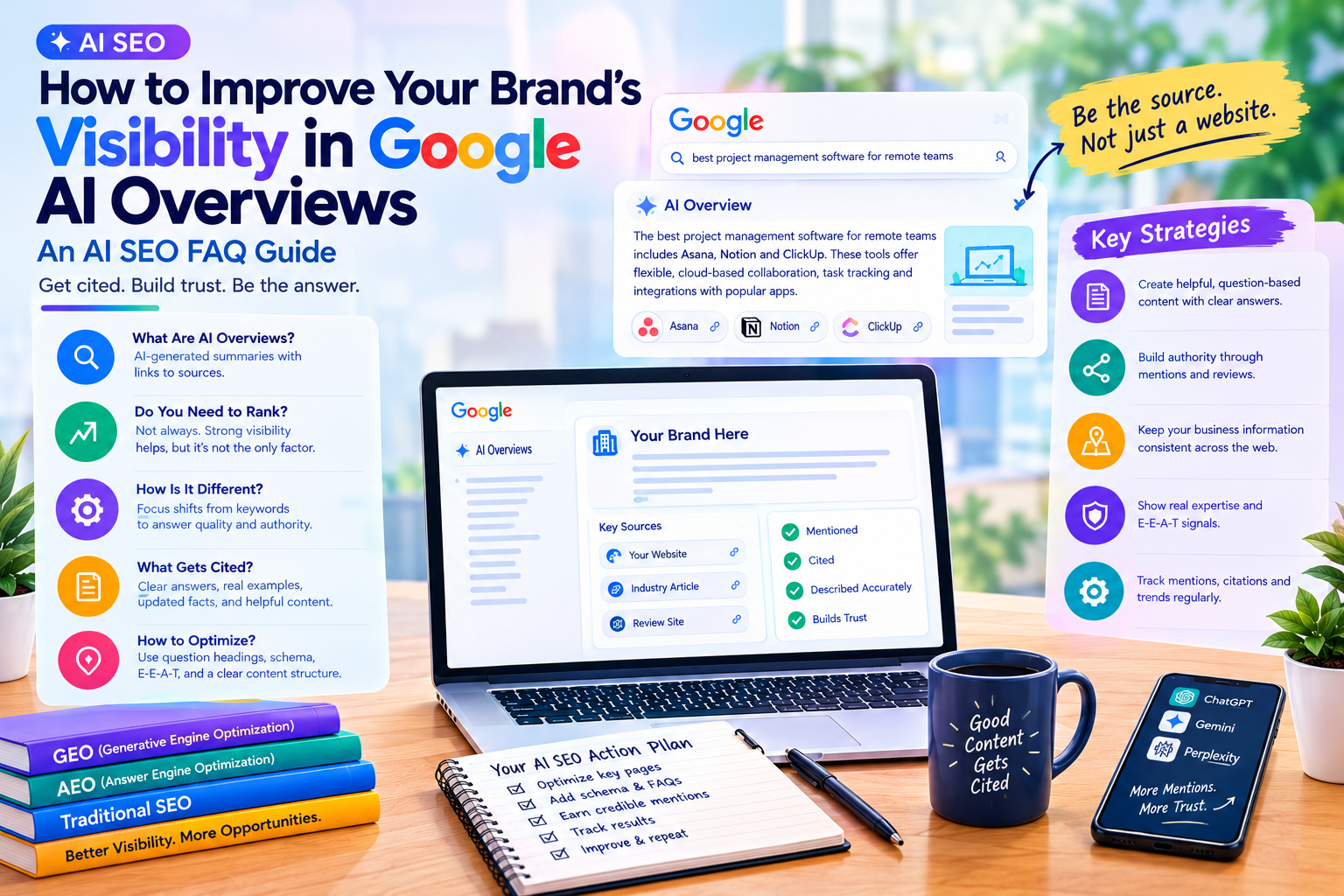
Google’s AI Overviews now sit at the top of many search results, answering questions before anyone clicks a link. For businesses, that changes the goal. Ranking is still useful, but being cited inside the summary is what earns attention and trust. This guide answers the questions we hear most about AI SEO and AI Overviews, in plain language.
What are Google AI Overviews, and why do they matter?
AI Overviews are AI-generated summaries that appear above the regular search results for many queries. They pull information from several web pages, combine it into a short answer, and show links to the sources.
They matter because they shape the first impression. If your brand is named or linked in that summary, you gain visibility even when the user never scrolls. If a competitor is cited instead, they get that moment of trust.
Do I need to rank on page one to appear in an AI Overview?
Not always, but strong organic visibility certainly helps. AI Overviews tend to draw on pages that Google already considers relevant and trustworthy. Rankings are a good starting point, but they are not the whole story.
Pages that answer a specific question clearly can be cited even when they don’t hold the top spot. That is good news for smaller businesses. Precision and clarity can beat sheer authority on narrow topics.
How is optimizing for AI Overviews different from regular SEO?
Traditional SEO asks, “Which page deserves the click?” AI Overviews ask, “Which source can be trusted to answer this question accurately?”
That shifts the focus from keyword placement to answer quality. Your content needs to be easy to extract, factually reliable and backed by a visible reputation. This is where GEO (Generative Engine Optimization) and AEO (Answer Engine Optimization) overlap with classic SEO. AEO helps you give the best short answer, and GEO helps you become the source that AI systems prefer to quote.
What type of content gets cited most often?
No one outside Google can publish an exact list, but patterns are easy to spot. Content that gets cited usually:
- answers one question directly, near the top of the section
- uses clear headings, often phrased as questions
- explains the “how” and “why,” not just the definition
- includes specific details such as steps, comparisons, examples or criteria
- is kept current, with accurate dates and facts
Think of each section as a small, self-contained answer. If a paragraph still makes sense when copied on its own, it is far more likely to be useful to an AI system.
How should I structure a page to win AI Overview citations?
Use a simple pattern:
- Write a question-style heading that matches how people actually search.
- Give a direct answer in two or three sentences immediately below it.
- Add depth afterwards with context, examples and steps.
- Use lists or tables when comparing options or explaining a process.
- Add an FAQ section at the end for related follow-up questions.
Support this with structured data where relevant, such as FAQ, Article, Organization and Product schema. It helps machines read your page, though it does not guarantee a citation.
Does brand authority really affect AI visibility?
Yes, and it is often underestimated. AI systems do not look at your website in isolation. They tend to favor brands that appear consistently and positively across the web: in articles, reviews, directories, forums and industry publications.
This is a big part of how we approach AI SEO at Sarkar SEO. A well-written page is only half the job. The other half is making sure your brand is described the same way, in the same context, in places beyond your own site.
What role do E-E-A-T signals play?
E-E-A-T stands for experience, expertise, authoritativeness and trustworthiness. Google has said these qualities guide how it evaluates content quality, and they are especially important in sensitive topics such as health and finance.
In practice, show real people behind your content. Add author names and short bios, cite credible sources, share first-hand examples, and make your contact details and business information easy to find. These small signals help both readers and algorithms decide whether you are worth trusting.
Can local businesses benefit from AI Overviews?
Absolutely. Many local searches, such as “best dentist near me” or “how much does roof repair cost,” trigger summaries that rely on business listings, reviews and local content.
For local GEO, keep your Google Business Profile complete and active, make sure your name, address and phone number match everywhere, collect genuine reviews, and publish pages that answer neighborhood-specific questions. Consistency matters more than clever tactics.
How do I measure whether my brand appears in AI Overviews?
There is no single dashboard that shows everything, so combine a few methods:
- Search your target questions manually and note whether your brand is mentioned or linked.
- Track impressions, clicks and click-through rate in Google Search Console, and watch how they change for question-type queries.
- Monitor branded search growth, since people who see you in a summary often search for you later.
- Review your referral traffic and enquiry sources for new patterns.
Repeat these checks monthly. AI-generated answers change often, so one snapshot is never enough.
What mistakes should I avoid?
- Keyword stuffing. It makes content harder to read and less useful as a source.
- Thin, generic AI-written content. If it says nothing new, it gives no reason to be cited.
- Ignoring updates. Outdated facts quietly reduce trust.
- Chasing guarantees. Be wary of anyone promising a permanent spot in AI Overviews. Visibility here can shift, and honest agencies, including Sarkar SEO, focus on building lasting credibility instead of shortcuts.
