



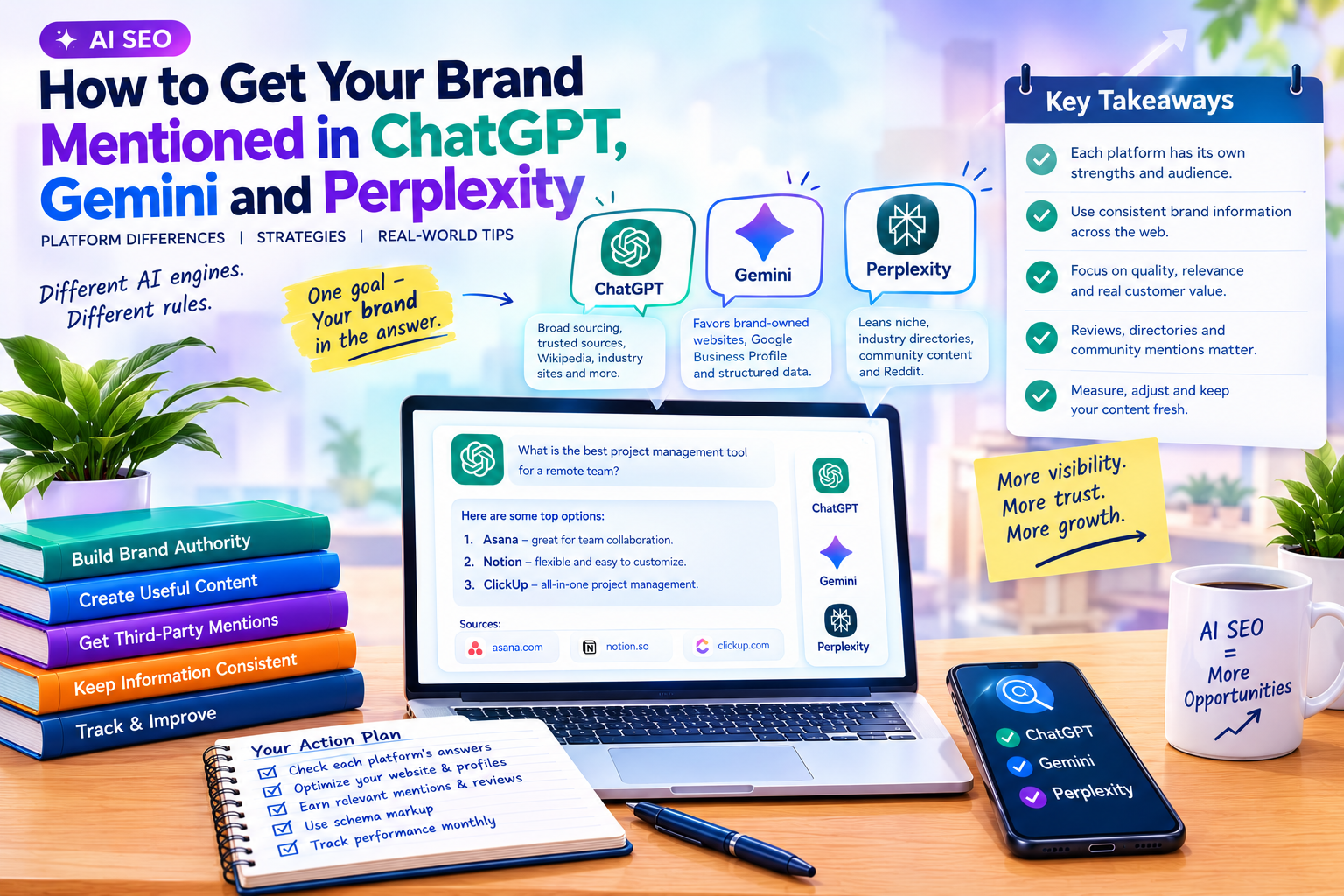
Many businesses assume that if they show up well in ChatGPT, they will show up everywhere. It doesn’t work that way. Each AI platform finds, weighs and presents sources differently, so a brand can be quoted constantly in one and missing in another. This FAQ explains how the three behave and what you can do about it as part of AI SEO.
Do ChatGPT, Gemini and Perplexity recommend the same brands?
Not usually. A large citation study from Wellows found that 79.6% of the sources the engines cite show up on one engine and nowhere else. The overlap is especially small for ChatGPT. Every pairing involving ChatGPT sat in the bottom four for shared citations.
In practice, treat each platform as its own audience. Ranking in one is a good sign but never proof that you are visible in the others.
How does Gemini decide what to mention?
Gemini leans heavily on information that brands control. In Yext’s analysis of 6.8 million citations, 52.15% of Gemini citations came from brand-owned websites, and it also draws on data from Google Business Profiles. Yext’s summary was that Gemini rewards ownership.
To improve your chances:
- Keep your website clear, accurate and well structured.
- Complete and maintain your Google Business Profile.
- Use relevant schema markup, such as Organization, Product, FAQ and LocalBusiness.
- Keep hours, services, locations and pricing details current.
How does ChatGPT decide?
ChatGPT tends to reward breadth. Yext’s reading was that ChatGPT rewards broad distribution and consistency across sources. In other words, it helps to be described the same way in many independent places, not only on your own site.
Other research suggests ChatGPT’s sources lean institutional: its top overall source in one large study was Wikipedia at 7.8% of citations, with social sources at just 5.3%. The practical takeaway is to build credible third-party coverage, such as industry publications, respected directories, reviews and recognized reference sources where appropriate.
How does Perplexity decide?
Perplexity is more specialized and more open to community content. Yext found it sources a bit more narrowly, leaning on industry-specific directories rather than general listings. Profound’s data adds that social sources made up 19.4% of Perplexity’s citations, and Reddit was its leading source.
That makes niche authority valuable. Detailed, topic-specific content, genuine community participation and a presence in directories for your industry all help. Fresh, well-sourced pages tend to suit Perplexity’s style of answering.
Is there anything that works across all three?
Yes. Despite their differences, all three models favor structured, consistent, verifiable data. That is the common ground:
- One clear description of your brand, used everywhere.
- Accurate facts, matching across your website, profiles and listings.
- Answer-first content that directly addresses real customer questions.
- Third-party validation through reviews, articles and credible mentions.
- Regular updates, so nothing contradicts anything else.
This is the foundation we build at Sarkar SEO before moving on to any platform-specific tactics.
What should I do first?
Start with a baseline. Ask each platform ten questions your customers would ask, such as “What is the best [your category] for [your audience]?” Record three things: whether you are mentioned, how you are described, and which sources are cited. Repeat monthly. This shows you which platform needs the most attention and what your competitors are doing better.
How can small businesses compete with bigger brands?
Narrow the question. AI tools answer specific prompts, and a small company that clearly owns a niche, a city or a use case can be the best answer to that smaller question. Build detailed pages for your specialty, collect honest reviews and make sure local and industry listings are complete. Perplexity in particular tends to surface niche and recent sources, which can give smaller brands room to appear.
Do reviews and community mentions really matter?
They do. AI systems look for outside confirmation of what a business says about itself. Genuine reviews, helpful forum answers and honest discussions create that confirmation. Never fake it, since fabricated reviews or astroturfed threads risk both penalties and your reputation. Encourage real customers to share real experiences, and respond to them professionally.
Should I create separate content for each platform?
Not separate content, but you can adjust emphasis. Write one strong, answer-first page, then support it differently. For Gemini, tighten your structured data and Business Profile. For ChatGPT, widen your third-party presence. For Perplexity, add specific, well-sourced detail and join relevant communities. One clear message with platform-aware support works better than three disconnected campaigns.
Can anyone guarantee a mention?
No. AI answers are generated dynamically and change over time, so be wary of any guarantee. Many of the figures above come from vendor and industry studies using different methods, so treat them as helpful direction and not fixed rules. A responsible agency such as Sarkar SEO focuses on what can be improved and measured: consistency, clarity, credibility and coverage.
