



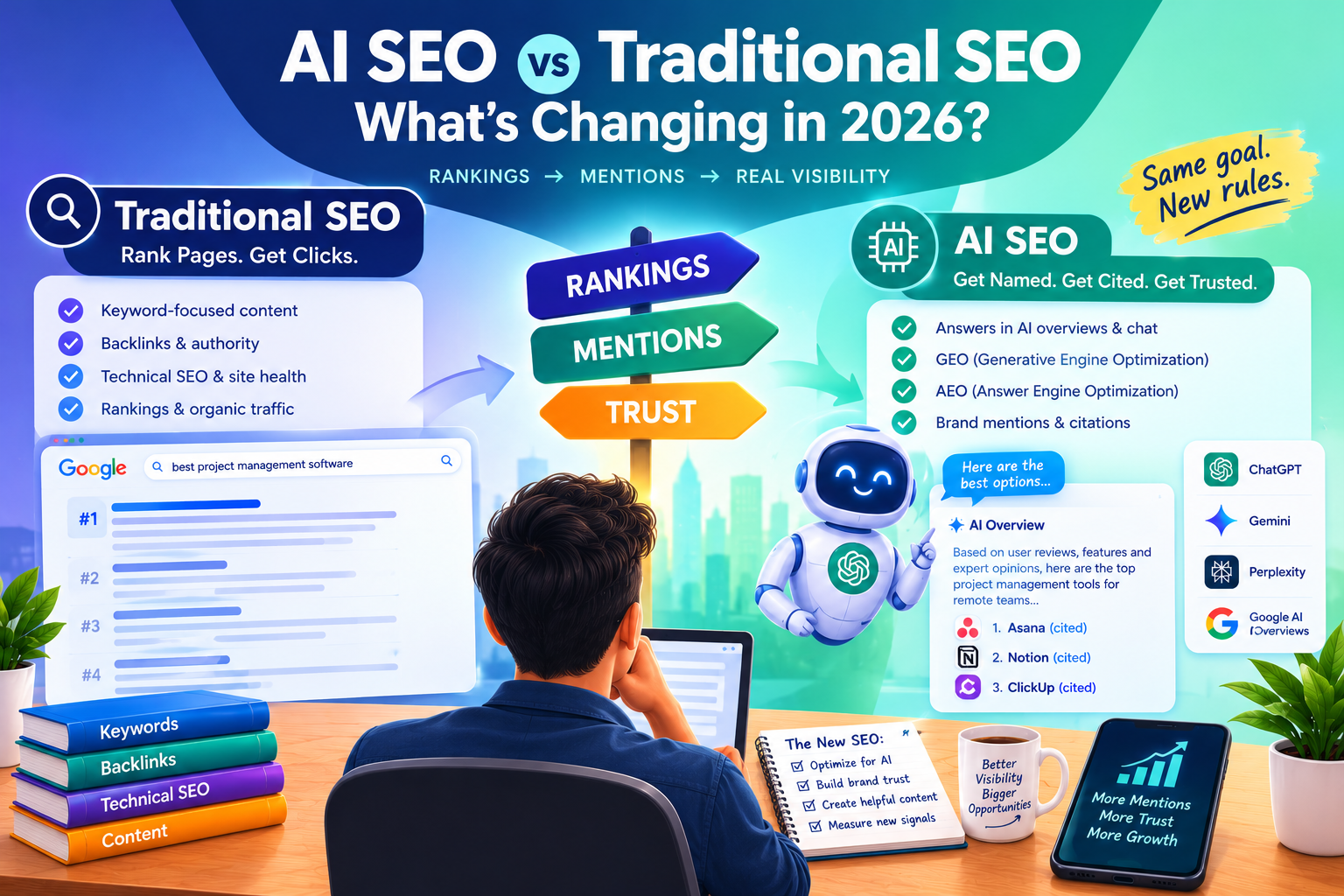
If your SEO reports still look the same as they did two years ago, there’s a good chance you’re measuring the wrong things. Search now includes AI assistants, answer boxes and summaries that respond before anyone clicks. This guide answers the most common questions about how AI SEO differs from traditional SEO and what to change this year.
Is traditional SEO dead?
No, and anyone who says so is exaggerating. Google still sends a huge amount of traffic, and the fundamentals still matter: crawlable pages, useful content, fast load times and trusted backlinks. AI search systems rely on the same open web that SEO has always worked on.
What has changed is the finish line. Traditional SEO aims to rank a page. AI SEO aims to get your brand understood, trusted and named inside the answer. Ranking is now one step toward that goal, not the whole goal.
What is the core difference between AI SEO and traditional SEO?
Think of it as two questions:
- Traditional SEO: “Which page should appear first for this keyword?”
- AI SEO: “Which brand or source should this answer be built from?”
The first question rewards pages. The second rewards entities, meaning clearly defined brands with consistent facts, real expertise and a reputation across the web. That is why AI SEO draws on GEO (Generative Engine Optimization) and AEO (Answer Engine Optimization) as well as classic on-page work.
How do GEO and AEO fit into this picture?
GEO focuses on being cited by generative tools such as ChatGPT, Gemini and Perplexity. AEO focuses on giving short, direct answers that can be pulled into snippets, voice results and AI summaries. Traditional SEO builds the foundation underneath both. In practice, a modern strategy blends all three instead of choosing one.
What is actually changing in 2026?
Five shifts stand out:
- Keywords are becoming questions. People type full sentences into AI tools, such as “What’s the best way to get my restaurant found by tourists?” Content should mirror that natural language.
- Brand mentions carry more weight. Being discussed in articles, reviews and communities helps AI tools verify who you are.
- Clicks are less guaranteed. More answers are delivered on the results page or inside the chat window, so visibility sometimes matters before traffic does.
- Structure matters more. Clear headings, direct answers and schema help machines extract your content accurately.
- Freshness is part of trust. Outdated facts quietly weaken a page’s usefulness.
Do keywords still matter?
Yes, but as topics, not as a count. Keyword research now works best when it uncovers the questions and concerns behind a search. A page that fully covers a topic, in the words real customers use, will usually serve both Google and AI tools better than one repeating a phrase fifteen times.
Do backlinks still matter for AI visibility?
They do, though the emphasis shifts from quantity to relevance. A mention on a respected, topic-related site builds authority and helps AI systems associate your brand with your niche. Random low-quality links add little. This is how we approach it at Sarkar SEO: every link or mention should make your brand clearer, not merely bigger.
How should I measure success now?
Rankings and organic sessions still belong in your report, but they no longer tell the full story. Add these:
- Brand mentions in AI answers. Test your key questions in ChatGPT, Gemini and Perplexity every month.
- How you’re described. Check whether the tone and facts are accurate.
- Branded search growth. People who see you in an AI answer often search for you afterward.
- Assisted conversions and enquiries. Ask new leads how they found you.
- Search Console trends. Watch impressions, especially on question-style queries.
There is no single dashboard for all of this yet, so a simple monthly checklist is more useful than waiting for perfect tools.
Should I rebuild my entire website?
Almost never. Start with the pages that matter most to revenue: your service pages, top blog posts and FAQs. Rewrite them answer-first, add clear author and business information, fix outdated facts and add relevant schema. Improving ten important pages well beats lightly editing a hundred.
Is AI-generated content a shortcut?
It’s a tool, not a shortcut. AI can help with outlines, research and drafts, but publishing generic text gives AI systems nothing new to cite. The content that earns trust includes real experience, original examples, honest opinions and accurate details that only your business can provide. Edit anything an AI tool writes until it sounds like a real person with something to say.
Can small businesses compete with bigger brands?
Often, yes. AI tools answer very specific questions, which gives focused businesses room to be the best answer for a narrow topic or location. A local clinic, a niche software company or a specialist agency can stand out by owning a clear area of expertise and describing it consistently everywhere.
Can anyone promise guaranteed AI rankings?
No. AI-generated answers vary by query, by user and over time. Be careful with anyone who guarantees a permanent spot in ChatGPT or Google’s AI results. At Sarkar SEO, we think the honest position is the useful one: strengthen the signals you control, measure regularly and adjust as the tools evolve.
