



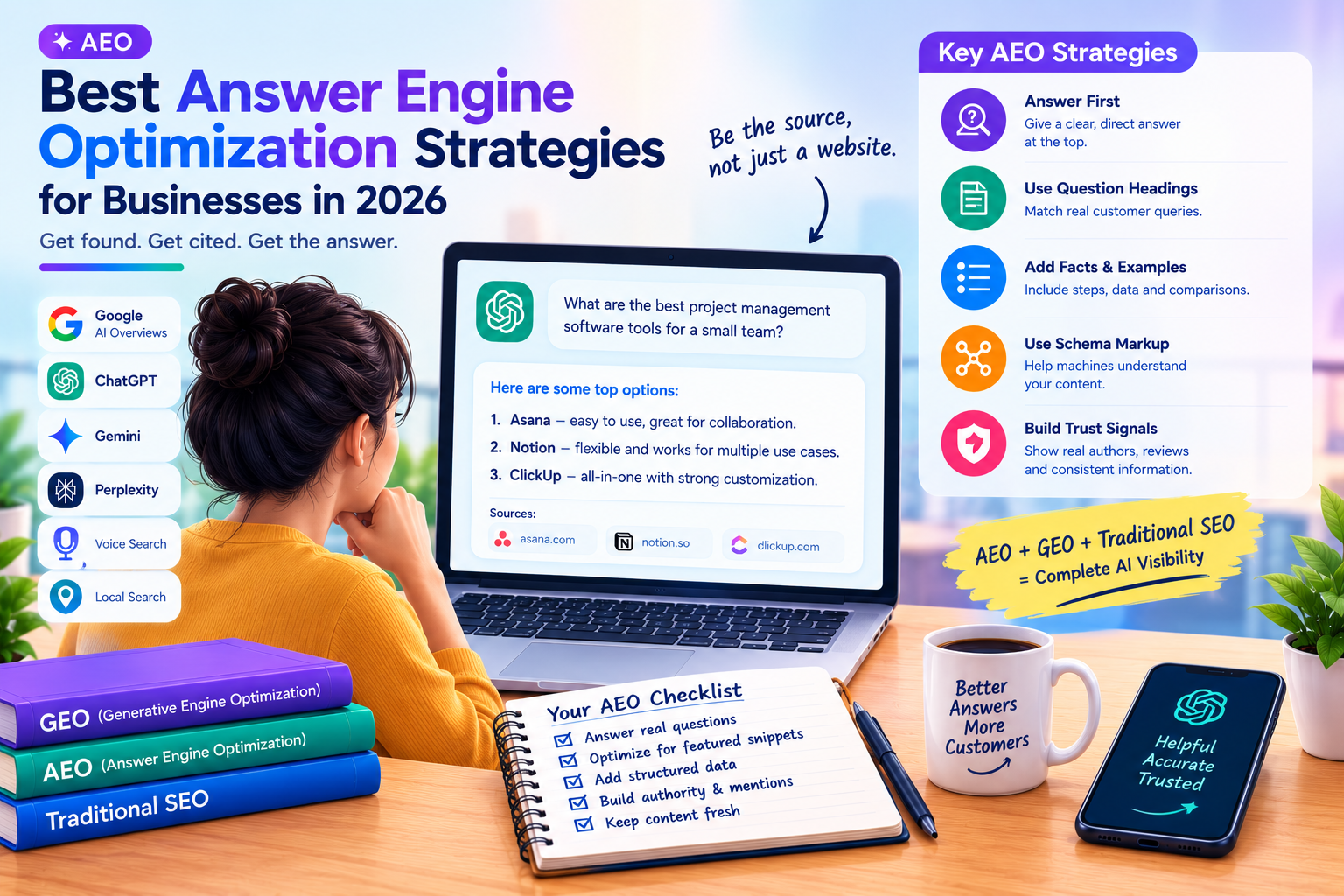
When someone asks a question today, the answer often appears before any website does. It might be a featured snippet, a voice assistant reply, a Google AI summary or a ChatGPT response. Answer Engine Optimization (AEO) is the practice of making your content the answer these systems choose. Here are the questions businesses ask us most, with practical replies.
What is Answer Engine Optimization?
AEO means structuring your content so search engines and AI assistants can pull out a clear, accurate answer and present it to the user. Where traditional SEO asks “how do I rank this page?”, AEO asks “how do I become the answer?”
It sits within the wider field of AI SEO, alongside GEO (Generative Engine Optimization). A simple way to separate them: AEO is about the quality and format of your answers, while GEO is about being trusted enough to be cited by generative tools such as ChatGPT, Gemini and Perplexity.
Why does AEO matter for businesses in 2026?
Because more of the buying journey now happens inside the answer. A potential customer might ask, “How much does a website redesign cost?” or “Which accounting software suits a small team?” and decide on a shortlist without opening ten tabs. If your business supplies the clearest answer, you are part of that shortlist. If not, you are invisible at the moment that matters.
What is the single most effective AEO strategy?
Write answer-first content. Under every heading, give the direct answer in two or three sentences, then add detail. Many businesses bury the answer after a long introduction, and that is the easiest thing to fix.
For example, if your heading asks “How long does SEO take to work?”, reply immediately with a realistic range and what it depends on. Then explain the factors. Readers get what they came for, and machines get a clean, extractable passage.
How do I find the right questions to answer?
Start with the people closest to your customers. Look at sales call notes, support emails, live chat transcripts and reviews. The wording customers use is gold, because it is usually the same wording they type into AI tools.
Then add these sources:
- Google’s “People also ask” boxes for your main topics
- Questions asked on forums and communities in your industry
- Autocomplete suggestions for your core services
- The follow-up questions AI assistants suggest after answering
Group them by topic, then build pages or FAQ sections around the clusters.
How should I format content for answer engines?
Keep it simple and scannable:
- Use question-style headings that match real queries.
- Put the direct answer first, in plain language.
- Use short paragraphs, around three or four lines.
- Use numbered lists for processes and bulleted lists for options.
- Use tables for comparisons, such as pricing tiers or feature differences.
- End the page with a short FAQ for related questions.
Avoid jargon unless your audience expects it. Clarity beats cleverness every time.
Does schema markup help?
It can help machines understand your pages, particularly FAQ, Article, Organization, LocalBusiness and Product schema. Think of it as a label on a box. It makes the contents easier to identify, but it does not make a weak page strong. Use it honestly, mark up only what is actually visible on the page, and keep it accurate.
How important are trust signals?
Very. Answer engines want sources they can rely on, so show your credibility openly. Add author names and short bios, cite reputable sources, include real examples from your own work and keep your business details easy to find. A page with an anonymous author and vague claims gives an AI system little reason to trust it.
This is also where we focus at Sarkar SEO. We look at how a brand is described across its website, profiles, listings and third-party mentions, because consistency across those places is part of what makes an answer engine confident enough to use you.
Should my FAQ pages be separate from my service pages?
Both can work, but the strongest approach is to place relevant FAQs directly on the pages where decisions are made. A service page with five honest, specific questions answered at the bottom helps visitors and gives answer engines clean material to use. A standalone FAQ hub is still useful for broader topics, as long as each answer is genuinely helpful and not a thin, repeated line.
How does AEO connect to local and voice search?
Closely. Voice assistants and local searches reward short, direct, location-aware answers. If you serve a city or region, include it naturally in your content, keep your Google Business Profile complete, and make sure your name, address and phone number match everywhere. Answer practical local questions, such as hours, service areas, pricing ranges and what to expect on a first visit.
How do I know if my AEO is working?
Track a mix of signals:
- Check target questions in Google, ChatGPT, Gemini and Perplexity each month and note whether you appear.
- Watch Search Console for growth in impressions on question-style queries.
- Track branded search growth, since people often look you up after seeing your name in an answer.
- Ask new leads where they heard about you.
Progress is gradual, so compare month to month and not day to day.
Can anyone guarantee an answer-box or AI mention?
No. Answers are generated dynamically and change often, so any guarantee should make you cautious. What a good partner such as Sarkar SEO can do is improve what you control: content clarity, structure, consistency and credibility. Those are the factors that raise your chances over time.
