



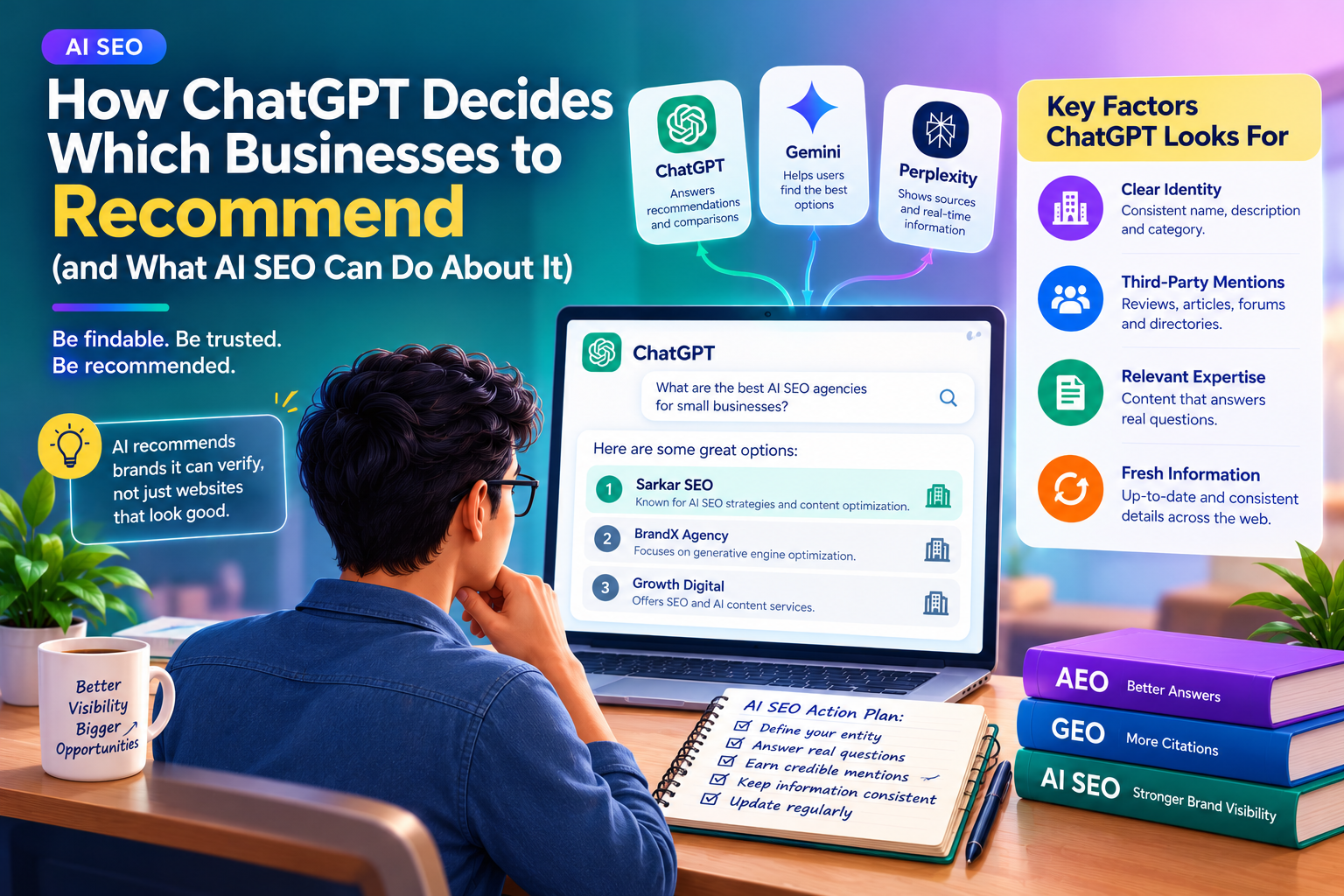
A few years ago, the goal was simple: reach page one of Google. Today, many buyers ask ChatGPT, Gemini or Perplexity for “the best option” and trust the shortlist they get back. If your business isn’t named in that answer, you may never enter the conversation. That is where AI SEO comes in. Below are the questions we hear most often, answered plainly.
What is AI SEO, and how is it different from traditional SEO?
AI SEO is the practice of making your brand easy for AI systems to find, understand, trust and quote. Traditional SEO aims to rank a page in a list of links. AI SEO aims to get your brand mentioned inside the answer itself.
The skills overlap, but the target changes. Google ranks pages. AI assistants build answers from sources they consider reliable, so your brand reputation across the web matters as much as your on-page keywords.
What are GEO and AEO, and how do they differ?
GEO (Generative Engine Optimization) focuses on being cited by generative tools such as ChatGPT, Gemini, Perplexity and Google AI Overviews. AEO (Answer Engine Optimization) focuses on giving short, direct answers to specific questions, so you can appear in featured snippets, voice results and AI summaries.
A simple way to remember it: AEO is about the quality of your answers, and GEO is about being chosen as the source. Both sit under the AI SEO umbrella, and you need both.
How does ChatGPT choose which businesses to recommend?
Nobody outside the AI labs knows the exact formula, and anyone who claims to is guessing. What we can observe is that AI tools tend to favor brands that show a few consistent signals:
- Clear identity: the same name, description and category everywhere your brand appears.
- Third-party mentions: reviews, articles, forums and directories that talk about you, not just your own site.
- Relevant expertise: content that answers real questions in your niche with depth.
- Fresh, consistent information: details that match across sources and stay up to date.
In short, AI recommends brands it can verify. This is the principle behind the work we do at Sarkar SEO: build a footprint the models can cross-check, not just a website that looks good.
How can I get my brand mentioned in ChatGPT, Gemini and Perplexity?
Start with these steps:
- Define your entity. Write one clear sentence about who you are and what you do, and use it consistently on your site, social profiles and listings.
- Answer questions people actually ask. Study the prompts your customers would type, such as “best AI SEO agency for SaaS”, and build pages around them.
- Earn mentions beyond your own site. Guest articles, industry roundups, honest reviews and community discussions all help.
- Keep facts consistent. Pricing, services and location should match everywhere.
- Update regularly. Stale pages lose trust quickly.
How should I structure content so AI can use it?
Think “answer first.” Put a direct two-to-three-sentence answer right under each heading, then add detail below it. Use descriptive headings written as questions, short paragraphs, and simple lists or tables where they help. Add FAQ sections and the relevant schema markup (FAQ, Organization, Article, Product) so machines can read the structure easily.
Avoid fluff. AI tools summarize, so every sentence should either answer something or support an answer. This is also the format that works best for AEO, which is why FAQ-style articles like this one perform well.
Does link building still help AI search visibility?
Yes, but the focus has shifted. Backlinks from relevant, respected sites still build authority, and they also create the third-party mentions AI tools appear to lean on. What has lost value is volume for its own sake. A handful of mentions on credible, topic-relevant sites will usually do more than hundreds of random links.
At Sarkar SEO, we treat links and brand mentions as one connected effort: every placement should make your brand clearer and more credible, not just add a backlink.
How do I know if my AI SEO is working?
Check your visibility manually and regularly. Ask ChatGPT, Gemini and Perplexity the questions your customers ask, and note whether you’re mentioned, how you’re described, and which sources are cited. Repeat monthly, since AI answers can change from one week to the next. For a deeper walkthrough, see our earlier guide on tracking your brand in AI search.
Also watch indirect signals: growth in branded searches, referral traffic from AI tools, and more inbound enquiries that mention finding you through an AI assistant.
Is AI SEO worth it for small businesses and SaaS companies?
Often, yes, and sometimes more so than for large brands. AI tools answer very specific prompts, which gives smaller, focused businesses a real chance to be recommended. A SaaS company that clearly owns a narrow use case, such as “invoicing software for freelancers”, can compete with much bigger names inside that niche.
The honest caveat is that results take time and no one can guarantee a particular mention. Be cautious of any promise of instant ChatGPT rankings. Steady, credible work is what compounds.
