



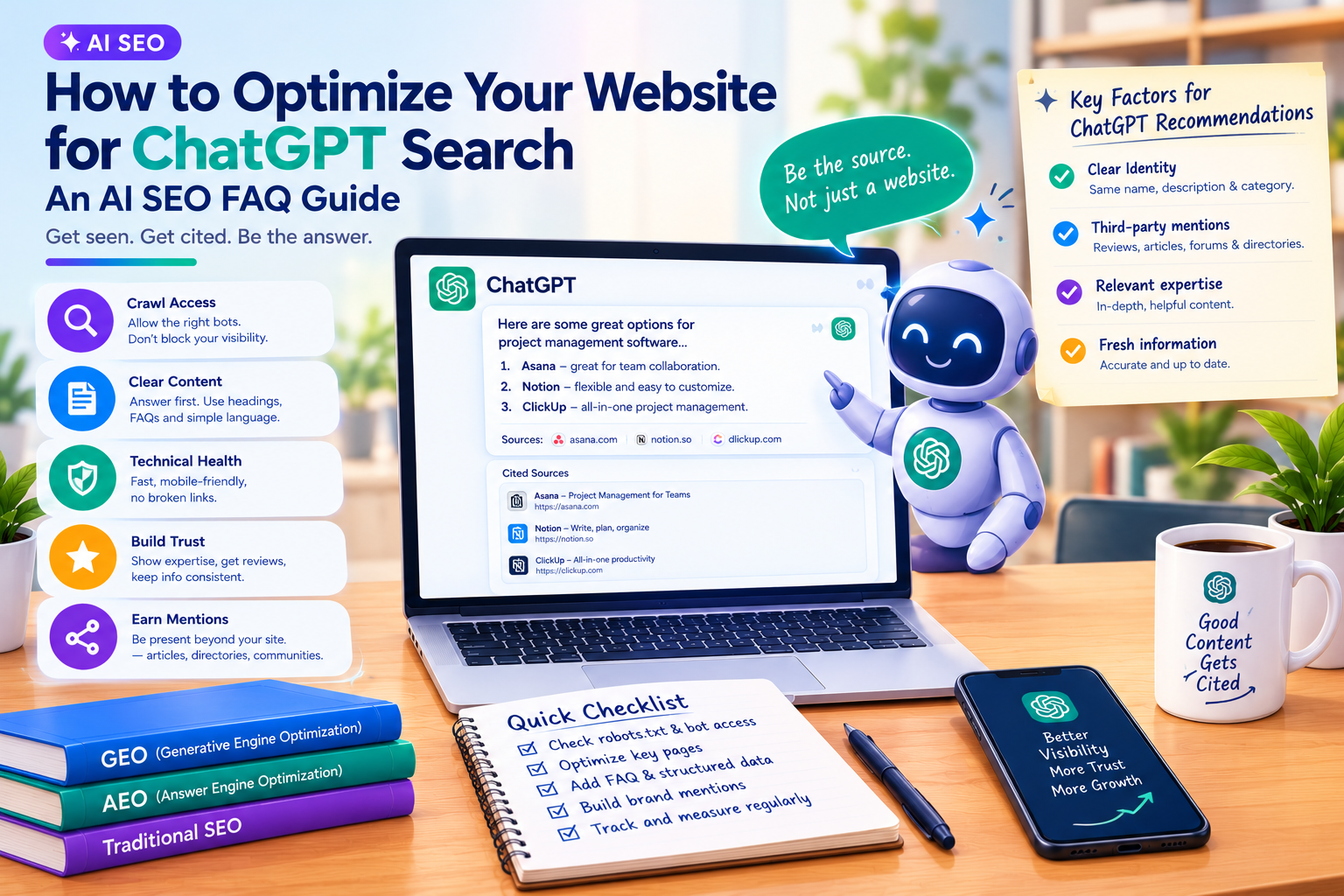
More people now use ChatGPT’s search features to find products, services and answers. Unlike a traditional results page, it gives a short answer with a few cited sources. This guide covers the questions we hear most often about getting your website into those citations, from the technical basics to the content side of AI SEO.
What is ChatGPT search, and why should my website care?
ChatGPT search lets the assistant look things up on the web and answer with links to its sources. If your pages are accessible, clear and trustworthy, they can become one of those sources. If they are blocked or hard to understand, a competitor’s page takes your place. Optimizing for it is a practical part of both GEO (Generative Engine Optimization) and AEO (Answer Engine Optimization).
Can ChatGPT even see my website?
This is the first thing to check, and it is where many sites quietly fail. OpenAI uses separate crawlers for separate jobs. A site can allow OAI-SearchBot so it appears in search results while disallowing GPTBot, which is the training crawler. Each setting is independent.
Many site owners block “the ChatGPT bot” without realizing there is more than one. Sites that opt out of OAI-SearchBot will not be shown in ChatGPT search answers, though they can still appear as navigational links. OpenAI also notes that it can take about 24 hours for a robots.txt change to take effect.
Open your robots.txt file today and check what it says about these bots. Also check that your firewall or security plugin is not blocking them by accident.
What is the difference between GPTBot and OAI-SearchBot?
GPTBot gathers content for training OpenAI’s models, while OAI-SearchBot indexes pages so ChatGPT can retrieve and cite them in search answers. If your goal is visibility, allow OAI-SearchBot. Whether to allow GPTBot is a separate business decision about training data, and it does not affect your search presence.
What kind of content does ChatGPT tend to cite?
No one outside OpenAI can give you a formula, so treat anyone who claims one with caution. What we see in practice is that cited pages are easy to extract and easy to trust. They usually:
- answer a specific question in the first few lines
- use clear headings that mirror real questions
- give concrete details such as steps, criteria, prices or comparisons
- show who wrote the content and why they are qualified
- stay accurate and up to date
If a paragraph still makes sense when pulled out on its own, it is much more useful to an AI system.
How should I structure a page for ChatGPT search?
Follow an answer-first pattern:
- Start with a heading phrased as the question a customer would ask.
- Give a direct answer in two or three sentences.
- Expand with context, examples and next steps.
- Use short lists or tables when comparing options.
- Finish with a small FAQ for related questions.
Add structured data such as FAQ, Article, Organization and Product schema where it fits. It helps machines read your page, but it works best alongside genuinely useful writing, not instead of it.
Does my brand reputation matter, or only my website?
Both. AI tools do not judge your site in isolation. They tend to favor brands that are described consistently across the web: in articles, reviews, directories and community discussions. This is the approach we follow at Sarkar SEO. We treat the website as the foundation, then work on how the brand is represented around it, so the story an AI tool finds is the same wherever it looks.
Start with the basics. Use the same business name, description and contact details everywhere. Keep your social profiles and directory listings current. Encourage honest customer reviews.
How do I optimize for conversational queries?
People talk to ChatGPT the way they talk to a colleague. Instead of “SEO agency Jaipur,” they ask, “Which agency can help a small business get found in AI search?” Write for that style.
Collect real questions from your sales calls, support emails and chat logs. Turn each into a heading and answer it plainly. This approach works for AEO as well, because direct, honest answers perform well in featured snippets, voice results and AI summaries.
Do page speed and technical SEO still matter?
Yes. A crawler cannot cite what it cannot load. Keep pages fast, mobile-friendly and free of broken links. Make sure important content appears in the HTML and is not hidden behind heavy scripts or pop-ups. Maintain an updated XML sitemap and a clean internal linking structure. Technical SEO has not become less important with AI search. It has become the entry ticket.
How can I tell whether ChatGPT is using my content?
Combine a few simple checks:
- Ask ChatGPT the questions your customers ask, and note whether you are mentioned or cited.
- Check your server logs for OAI-SearchBot visits. Seeing it show up regularly is a good sign that your content is being indexed.
- Watch for referral traffic from chatgpt.com in your analytics.
- Note any enquiries where customers say they found you through an AI assistant.
Repeat these checks monthly, because AI answers change often.
Can anyone guarantee a ChatGPT recommendation?
No, and that is worth saying clearly. AI tools generate answers dynamically, so no agency, including Sarkar SEO, can honestly promise a permanent mention. What we can do is improve the signals that make a mention more likely: accessible pages, clear answers, consistent facts and credible third-party coverage.
