



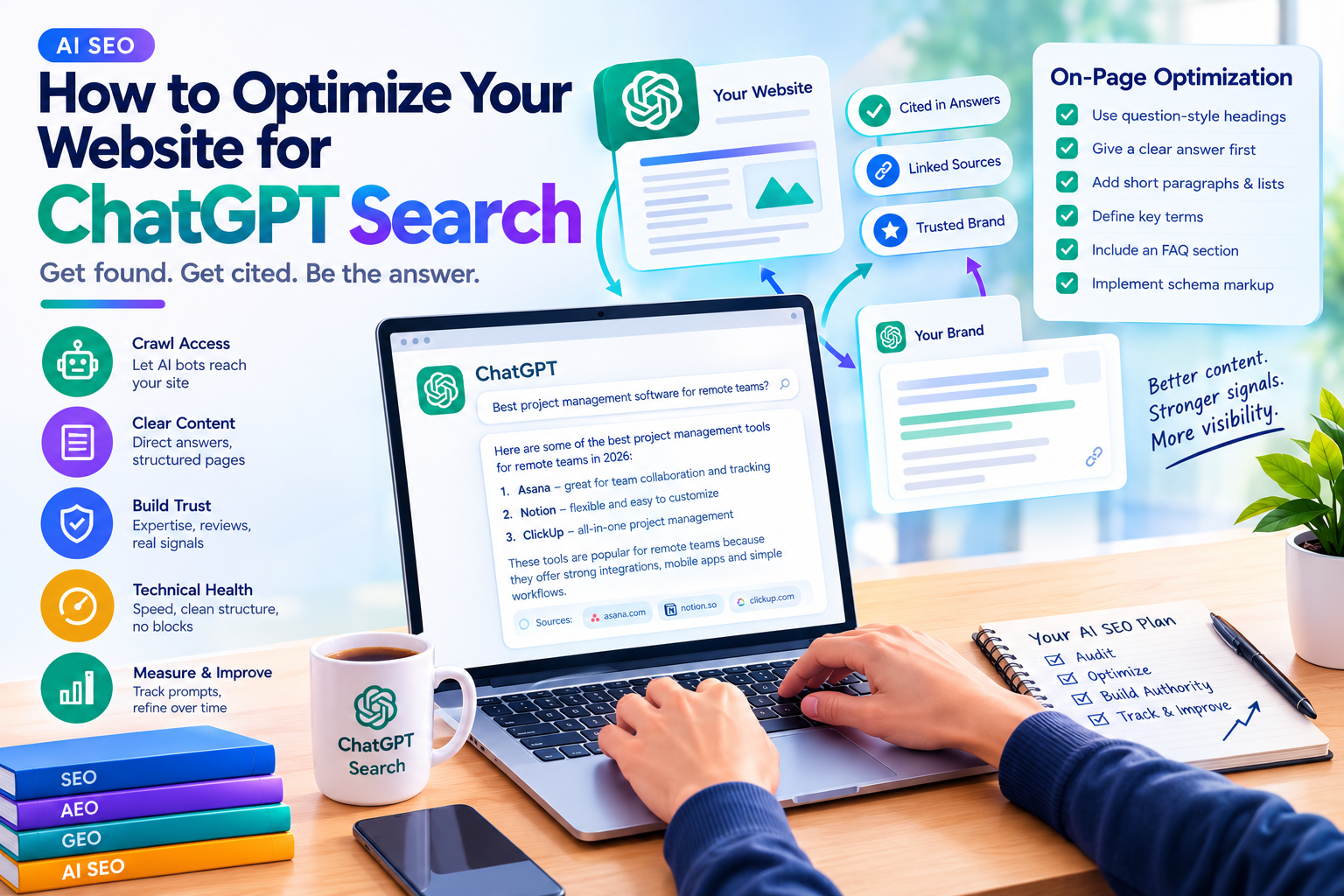
When ChatGPT searches the web, it reads your site differently from how a human visitor does. It’s looking for clear, reliable passages it can pull into an answer, and it may link back to the pages it used.
That creates a new kind of optimization, and it’s one of the most practical parts of AI SEO. This guide covers what to fix on your site, in the order that tends to matter most.
Can ChatGPT actually see my website?
Only if it’s allowed to and able to. Two basics decide that:
- Crawl access. Your robots.txt file and security settings shouldn’t block the crawlers you want. OpenAI publishes documentation on its different bots, including one used for search and another used for model training, so check the current guidance before changing anything.
- Readable pages. Content hidden behind logins, heavy scripts or pop-ups is harder for any crawler to read.
Many sites lose visibility here without realizing it, so start with a quick access check.
What does ChatGPT want from a page?
In simple terms: pages that are clear, direct and trustworthy. That generally means:
- A specific topic per page
- A plain-language answer near the top
- Supporting detail underneath
- Clear signs of who wrote it and why they’re credible
- Up-to-date information
If a human skimmer can understand your page in thirty seconds, a machine probably can too.
How should I structure content for answers?
Use AEO principles:
- Question-style headings. “How much does a website audit cost?” beats “Pricing overview.”
- Answer first. Give a one- or two-sentence response, then expand.
- Short paragraphs and lists. They’re easier to extract cleanly.
- Define terms. A crisp definition is highly quotable.
- Add an FAQ block. Short, self-contained answers are perfect for extraction.
Avoid burying key facts inside long, flowery introductions.
Does schema markup help?
Structured data helps systems interpret your pages accurately. Organization, Article, FAQ, Product, LocalBusiness and Review schema can clarify what’s on a page and who it belongs to. Nobody can promise that schema alone will earn a mention, but it removes ambiguity, and ambiguity is a common reason good content gets overlooked.
Why do page speed and site health still matter?
Because AI tools that fetch pages in real time behave a lot like any other crawler. Slow pages, broken links, redirect chains and duplicate content make your site harder to read and easier to skip. Fix them like you always would. Sarkar SEO treats technical cleanup as the first step on every AI SEO project, since stronger content can’t help if it can’t be reached.
How do I show expertise and trust?
Make it obvious who is behind the content:
- Named authors with short, real bios
- An About page that states what you do, who you serve and where you operate
- Contact details that match across your site and external profiles
- Original examples, data or case studies, not recycled generic advice
- Dates, with visible updates when information changes
Trust signals help both people and machines decide whether to rely on you.
Should I create new pages or fix existing ones?
Fix first. Pick your most important pages, such as service pages, pricing, key comparisons and top articles, and rebuild them for clarity. Then add new pages for gaps: questions your customers ask that you haven’t answered, or use cases you haven’t described.
We often find that ten well-rebuilt pages do more than fifty new ones.
Do off-site signals matter for ChatGPT search?
Yes. Even when ChatGPT fetches live pages, it tends to favor sources that look credible and corroborated. Reviews, mentions on reputable sites, consistent business profiles and expert commentary all reinforce your site. Treat your website as the hub and the rest of the web as the evidence that supports it.
How can I test whether my pages work?
Try this monthly routine:
- List 15 to 20 questions your customers genuinely ask.
- Run them in ChatGPT with search enabled.
- Note whether your site is cited, how your brand is described, and which competitors appear.
- Update the pages tied to missed prompts, then retest next month.
Sarkar SEO uses this loop to show clients what’s changing instead of guessing. Results will vary between runs, so watch the pattern over time.
Is there a guaranteed way to get cited?
No. Anyone who promises that is overselling. You can improve the odds by being accessible, clear, credible and current, and by measuring honestly.
The bottom line
Optimizing for ChatGPT search starts with access, then clarity, then credibility. Make your pages easy to read and easy to quote, and back them up with trustworthy signals across the web.
If you’d like a practical review of how your site performs for AI-driven search, Sarkar SEO can audit your key pages and map out the fixes in priority order.
